How IoT Device Makers Integrate Contactless Vital Signs
How IoT device contactless vital signs integration works across cameras, edge AI, firmware, and product architecture for OEM teams building health sensing devices.
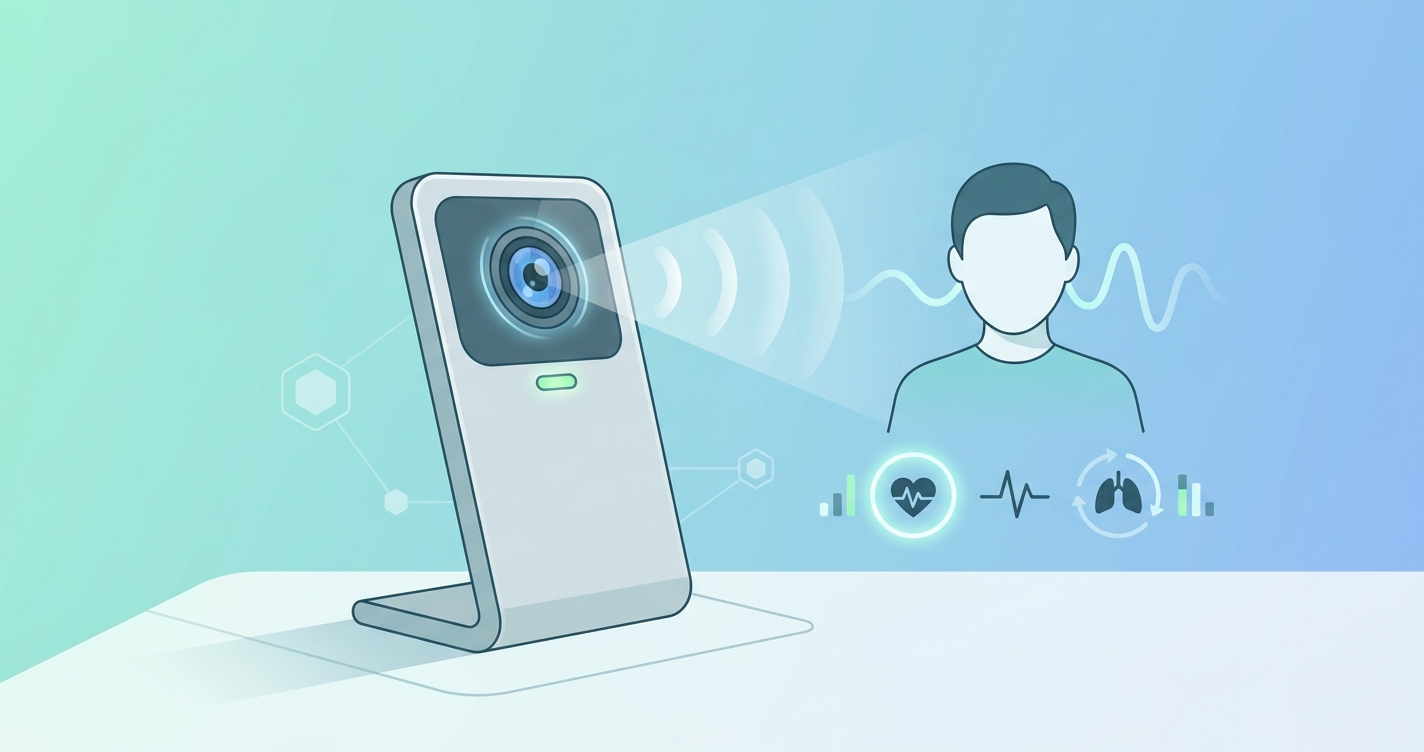
IoT device contactless vital signs integration is no longer a lab-only question. Hardware OEMs and connected-device teams now have to decide where the sensing stack lives, how much compute sits on-device, what kind of camera data survives the ISP, and how the output fits into a product that still has to ship on time. The shift becomes real the moment a team tries to add heart rate or respiratory rate to a kiosk, smart display, cabin camera, or wellness terminal and realizes the hard part is not the demo. It is the integration.
"The COVID-19 pandemic further accelerated research and investment in contactless sensor technologies to minimize interactions between patients and healthcare providers," wrote Muhammad Salman Raheel, Faisel Tubbal, Raad Raad, Philip Ogunbona, and James Coyte in their 2024 survey on contactless vital sign monitoring systems for IoT and sleep applications.
IoT device contactless vital signs integration starts with system architecture
Most product teams begin with the sensor and end up redesigning the whole device. Contactless vital signs are usually presented as a model feature, but the real integration surface is much wider:
- Camera or radar sensor selection
- Optics, illumination, and enclosure geometry
- ISP behavior and frame access
- Edge compute budget
- Temporal buffering and signal-quality logic
- Firmware and OTA update strategy
- Data pipelines for cloud reporting or fleet analytics
That is why the question is rarely "Can we add contactless vitals?" A better question is "What architecture lets this product capture a usable physiological signal on the hardware we actually plan to ship?"
A 2025 review by Ahmad Hassanpour and Bian Yang argues that the field is moving away from single-modality, single-parameter systems and toward multi-modal, multi-task designs. For IoT makers, that shift matters. A smart device may need to combine RGB video, NIR illumination, thermal sensing, or occupancy context rather than depend on one clean webcam stream in perfect light.
| Integration layer | What the IoT team decides | Why it matters for contactless vitals |
|---|---|---|
| Sensor stack | RGB, NIR, thermal, radar, or mixed modalities | Signal quality starts with what the hardware can actually see |
| Optics and lighting | FOV, distance, active illumination, glare control | Small design choices can raise or crush SNR |
| Edge compute | MCU, mobile SoC, GPU, or accelerator | Determines whether inference can happen locally |
| Firmware pipeline | Exposure control, frame timing, buffering | Physiological signals are sensitive to timing drift |
| Product UX | Passive monitoring, prompted scan, or periodic check | User behavior changes motion artifact patterns |
| Cloud integration | Raw frames, features, or summary metrics | Privacy, bandwidth, and fleet operations all change here |
In practice, successful teams treat contactless vitals as a product architecture decision, not a bolt-on feature.
Why integration gets harder after the proof of concept
Early demos usually run in controlled light with stable framing. Real products do not. Kiosks face queueing behavior and changing distance. Smart displays sit near windows. Automotive and industrial devices work under vibration, low light, or active infrared. Consumer IoT products add another complication: the device may already be CPU-bound before physiological sensing is added.
Xin Liu, Brian Hill, Ziheng Jiang, Shwetak Patel, and Daniel McDuff made a useful point in EfficientPhys (WACV 2023). They showed that camera-based cardiac measurement can be made simpler and faster by removing heavy preprocessing steps and working directly from raw video inputs, with their lightest network improving efficiency by 33%. For IoT teams, that matters because every preprocessing step has a cost in latency, power, memory, or engineering complexity.
I keep coming back to this because many integration plans still assume the model is the expensive part. Often it is the surrounding machinery:
- Face or region-of-interest tracking
- Exposure normalization
- Temporal window management
- Confidence scoring
- Retry logic when motion breaks the signal
- Device-side telemetry and watchdog handling
If those pieces are ignored, the product might look fine in a benchmark and still fail in the field.
Common integration patterns IoT device makers use
There is no single blueprint, but four patterns show up repeatedly.
Edge-first camera integration
This pattern keeps capture, signal extraction, and at least part of inference on the device. It is common when latency, privacy, or unreliable connectivity make cloud-heavy designs unattractive.
Zahid Hasan, Emon Dey, Sreenivasan Ramasamy Ramamurthy, Nirmalya Roy, and Archan Misra showed in RhythmEdge (SMARTCOMP 2022) that edge-based contactless heart-rate estimation could run on devices such as Jetson Nano, Google Coral, and Raspberry Pi. Their prototype cut model size by 87% and inference time by 70%, while operating with about 8 W maximum power draw, 290 MB memory use, and latency as low as 0.0625 seconds.
That does not mean every IoT product should run full inference locally. It does mean edge deployment is realistic when the stack is built for the target hardware instead of copied over from a desktop experiment.
Hybrid edge-cloud integration
Here, the device handles capture, quality scoring, and maybe partial inference, while the cloud manages analytics, model updates, and fleet-level reporting. This is often the middle ground for teams that need strong device autonomy but still want centralized observability.
Fixed-environment kiosk integration
Kiosks, mirrors, and assessment terminals usually benefit from controlled geometry. Distance can be constrained. Illumination can be designed into the enclosure. That makes contactless vitals more tractable, but it also means the model should be trained on the actual camera and lighting stack, not a generic public dataset.
Multi-modal IoT integration
Some products use more than one sensing path. A camera may estimate pulse-related signals while radar or thermal sensing supports respiration or presence checks. Hassanpour and Yang's 2025 review is useful here because it describes the rise of signal-level, feature-level, and decision-level fusion. In plain English, teams are no longer forced to bet the whole product on one sensor stream.
What OEM teams compare before they commit
Before an integration moves from prototype to roadmap, buyers usually compare tradeoffs more than algorithms.
| Design choice | Typical benefit | Typical cost |
|---|---|---|
| Full on-device inference | Lower latency, less raw video movement | Higher power and thermal pressure |
| Partial edge inference | Better resilience than cloud-only | More split-stack complexity |
| Cloud-heavy design | Easier central updates | Network dependency and broader privacy review |
| Camera-specific training | Better fit to real hardware | More data collection and validation work |
| Multi-modal sensing | More robust across environments | More BOM and fusion complexity |
A few questions come up again and again:
- Does the product need to work when connectivity drops?
- Will the device use RGB, NIR, or another imaging path?
- How much access does the team have to pre-ISP or minimally processed frames?
- Can the thermal envelope tolerate sustained inference?
- Is this passive ambient monitoring or a user-initiated check?
Those questions sound operational, but they usually decide whether the contactless vital-sign feature survives product review.
Industry applications
Smart kiosks and wellness terminals
These devices have one big advantage: they can guide user positioning. That reduces some motion problems and makes it easier to tune lighting. The downside is throughput. A product may need to produce a stable reading without asking the user to stand still for too long.
Automotive and cabin-adjacent systems
Cabin environments put pressure on low-light performance, vibration tolerance, and edge compute. Even when the program is not strictly automotive, the same constraints show up in rugged mobile systems and industrial vehicles.
Smart displays and consumer IoT devices
These products often have limited thermal headroom and a camera already assigned to other tasks such as conferencing, authentication, or occupancy. Integration succeeds only if the physiological stack can coexist with the rest of the software budget.
Specialized hardware programs
Some teams are building around unusual sensors, optics, or embedded accelerators. In those cases, generic models are usually the wrong starting point. A camera-specific approach is closer to what posts like Why One-Size-Fits-All rPPG Models Fail: Camera-Specific Training have already argued, and it often pairs with decisions around What Is Edge Deployment? Running rPPG on Embedded Hardware.
Current research and evidence
The evidence base says two things at once. First, contactless monitoring is broadening beyond a single technique. Second, deployment still depends on engineering discipline.
Raheel, Tubbal, Raad, Ogunbona, and Coyte's 2024 survey maps the field across microwave radar, Wi-Fi, and visible-spectrum approaches, with a particular focus on continuous heart-rate and respiration monitoring in IoT and sleep settings. That is a reminder that product teams can choose among several sensing families depending on environment and cost.
Hassanpour and Yang's 2025 review describes the move toward multi-modal, multi-task systems that estimate several cardiac and respiratory measures within a shared framework. That is relevant for IoT product planners because buyers increasingly ask for a platform capability, not a single metric.
Liu, Hill, Jiang, Patel, and McDuff's EfficientPhys work from 2023 makes a different point: trimming preprocessing can make camera-based measurement more deployable on constrained systems. Their reported 33% efficiency improvement is the kind of result embedded teams notice because it translates into real product options.
Then there is the edge-compute evidence. Hasan, Dey, Ramamurthy, Roy, and Misra's RhythmEdge system showed that a contactless heart-rate stack could be profiled on low-resource platforms with 8 W power, 290 MB memory, and 0.0625-second minimum latency. For an IoT architect, those are not marketing numbers. They are planning inputs.
The future of IoT device contactless vital signs integration
I do not think the market is heading toward one universal vital-sign model dropped into every camera product. The direction looks messier than that, and more practical.
First, more device-specific model work. Different sensors, ISPs, frame timings, and illumination setups keep pushing teams toward custom training.
Second, more hybrid deployments. Local processing is increasingly attractive for privacy and latency, but centralized systems still matter for monitoring fleets, updating models, and tracking device health.
Third, more multi-modal design. Teams want fallback paths when light is poor, positioning is unstable, or a single sensor stream degrades.
That is less elegant than the old story about one AI model solving everything. It is also much closer to how products actually get built.
Frequently Asked Questions
How do IoT device makers integrate contactless vital signs into a product?
Usually by combining sensor selection, frame access, signal extraction, edge inference, and product-level data handling rather than dropping in a model alone.
Does contactless vital-sign integration always require edge AI?
No. Some systems are cloud-heavy, some are hybrid, and some are edge-first. The right split depends on latency, privacy, bandwidth, and device compute.
Why is camera-specific training important for IoT deployments?
Because the target camera, optics, illumination, and ISP pipeline can change the physiological signal enough that a generic model no longer transfers well.
Are multi-modal systems becoming more common?
Yes. Recent reviews show growing interest in combining modalities and estimating several vital signs in one framework, especially when a single sensor struggles across environments.
If your team is evaluating a device-specific path for contactless monitoring, Circadify is building for that part of the market. You can start a custom build conversation here: circadify.com/custom-builds.