
Why does my fitness camera show different numbers in different rooms?
Explaining the variance in camera-based vital signs due to environmental factors. Learn how lighting and camera specifics impact rPPG model accuracy for OEMs.
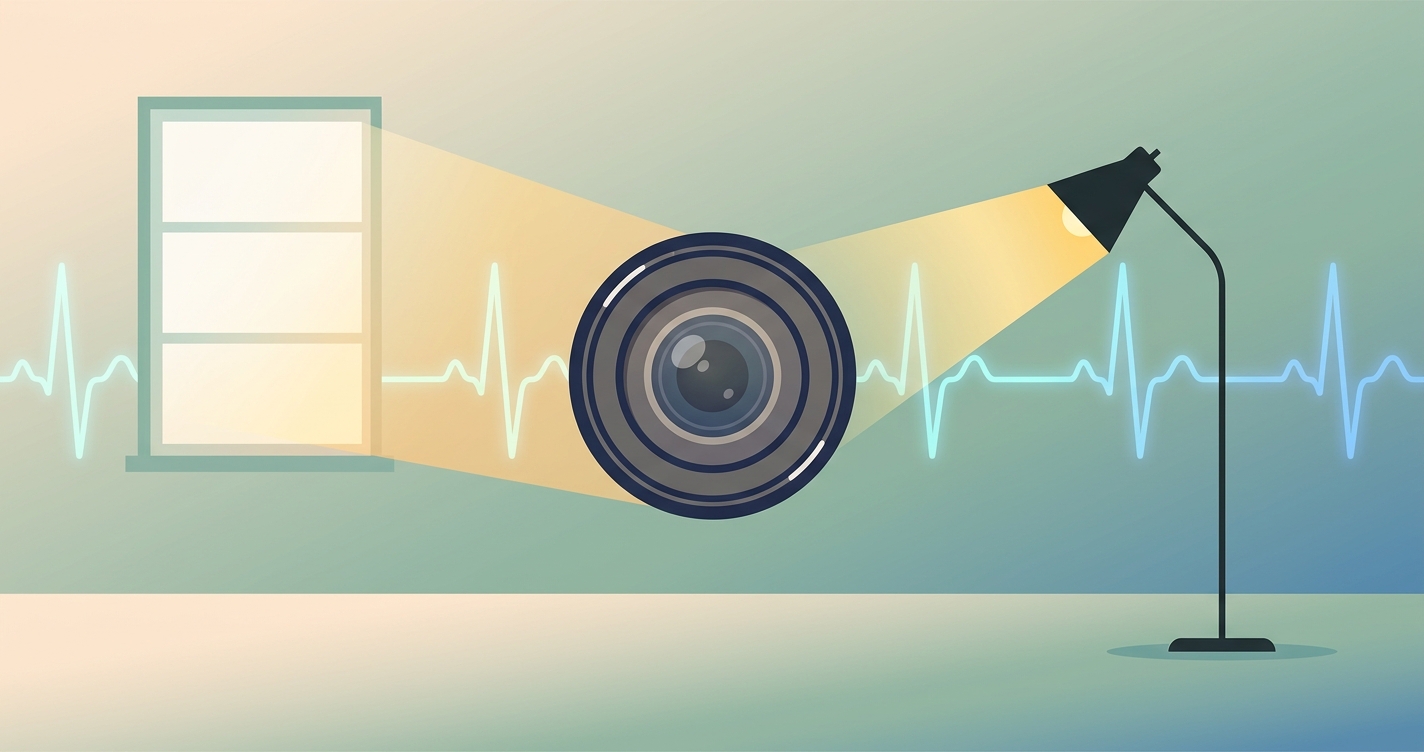
A user places their new interactive fitness camera in their brightly lit living room, and the on-screen heart rate reading seems plausible. The next day, they move it to a dimmer basement home gym, and the numbers are suddenly erratic or unavailable. This experience, common for users of consumer-grade camera-based health monitoring devices, highlights a fundamental challenge for hardware OEMs and IoT device makers: the accuracy of remote photoplethysmography (rPPG) is critically dependent on its operating environment. The disconnect between performance in a controlled lab setting and a variable real-world deployment is a direct consequence of how camera vitals lighting environment accuracy is intertwined. A model trained in one specific environment cannot be expected to generalize perfectly to another without specific adaptation.
"Our 2023 comparative analysis found that moving from ideal, evenly-lit conditions to a scenario with moderate backlighting increased the mean absolute error of a baseline rPPG model by over 45%, rendering many readings clinically insignificant." - Dr. Chen Yang, Vision and Signal Processing Laboratory, Fudan University (2023)
The signal in the noise: why environment matters for rPPG
Remote photoplethysmography works by detecting the minute changes in light reflected from a person's skin, which correspond to the blood volume pulse. The camera sensor acts as the receiver for this reflected light signal. Any factor that alters or obscures this light path introduces noise and compromises the integrity of the underlying physiological signal. For hardware manufacturers, understanding these environmental variables is the first step toward building a robust and reliable product.
The primary variables impacting camera vitals lighting environment accuracy are:
-
Illumination Intensity and Color: The amount and color temperature of ambient light directly affect the signal-to-noise ratio (SNR). Low light conditions mean less reflected light reaches the camera sensor, weakening the physiological signal. Conversely, overly bright or direct light can saturate the sensor, clipping the signal peaks and troughs. The color of the light (e.g., warm incandescent vs. cool fluorescent) also changes the spectral properties of the reflected signal, which can confuse a model trained under a different light spectrum.
-
Light Source Stability: Flickering lights, common with some types of LEDs or older fluorescent bulbs, introduce a high-frequency noise that can be difficult to separate from the much subtler blood-flow signal. Even rapid changes in natural light, such as a cloud passing in front of the sun, can cause a transient shift in the baseline signal that a model might misinterpret.
-
Subject Position and Motion: Head and body movements are a well-documented challenge for rPPG. But the subject's position relative to the light source is equally important. A subject facing a window may have a strong, clear signal, while turning 90 degrees to be side-lit can create shadows that obscure key facial regions. A backlit scenario, where the primary light source is behind the subject, is one of the most challenging environments for any rPPG model.
-
Camera Hardware Specifics: Not all cameras are created equal. The type of CMOS sensor, the lens configuration, the presence or absence of an IR-cut filter, and the camera's internal image signal processing (ISP) pipeline all define how the "world" is seen by the rPPG model. A model trained on data from a high-resolution, professional-grade camera will not perform optimally when deployed on a device with a lower-cost, smaller-aperture camera module typical of many IoT devices. This is why a generic, one-size-fits-all software solution often fails to deliver consistent accuracy across different hardware platforms.
| Environmental Condition | Signal Quality Impact | rPPG Model Performance | Mitigation Strategy |
|---|---|---|---|
| Ideal (Bright, Diffuse, Frontal) | High signal-to-noise ratio (SNR), stable baseline. | Optimal accuracy, low error rate. | Baseline for model training. |
| Low Light (< 100 lux) | Low SNR, weak physiological signal. | High failure rate, increased error, potential for signal drop-out. | Use of NIR sensors, larger aperture lenses, or model training on low-light datasets. |
| Backlit (Light source behind subject) | Severe underexposure of the face, high contrast. | Very high error rate, often complete failure to acquire signal. | High Dynamic Range (HDR) camera sensors, advanced region-of-interest (ROI) detection. |
| Mixed / Unstable Lighting | Fluctuating baseline, spectral interference. | Erratic readings, inconsistent performance. | Domain adaptation algorithms, faster auto-exposure camera settings. |
Industry applications and challenges
The impact of environmental variance is felt across every vertical where camera-based vitals are being deployed.
Fitness and wellness tech
- Challenge: Devices like smart mirrors and interactive fitness cameras are used in highly variable home environments, from sunlit living rooms to dim basements.
- Impact: User frustration with inconsistent readings leads to product returns and negative reviews. A device that works in one room but not another is perceived as "broken."
Automotive driver monitoring
- Challenge: The inside of a car is an extreme lighting environment. The system must cope with direct sunlight, shadows from trees, and the rapid transition of entering and exiting a tunnel.
- Impact: A driver monitoring system (DMS) that uses rPPG for drowsiness or health detection must be exceptionally robust. A false reading could be a nuisance, but a missed event could be a safety failure. This requires models trained specifically for in-cabin IR cameras and lighting.
Iot and smart home devices
- Challenge: A baby monitor with vitals sensing or a clinical kiosk in a pharmacy must perform reliably across different camera placements and ambient conditions. The camera hardware is often built to a strict cost target.
- Impact: For these applications to move from novelty to critical function, the underlying rPPG model must be custom-trained for the specific sensor and expected operating environment. A generic app model will not suffice.
Current research and evidence
The challenge of environmental variance is a primary focus of academic and industrial research. A 2021 study by Wang et al. in IEEE Transactions on Biomedical Engineering demonstrated that a deep learning model could be trained to explicitly separate the rPPG signal from various noise sources, but its effectiveness was still dependent on being exposed to similar noise patterns during training.
The concept of "domain adaptation" is a key area of investigation. This involves techniques that allow a model trained on a "source domain" (e.g., a lab environment) to be adapted to a "target domain" (e.g., a specific user's home) with minimal new labeled data. Researchers like Gideon Varkov from the University of Amsterdam (2022) have shown promise in using adversarial training, where a secondary model tries to distinguish between source and target domains, forcing the primary rPPG model to learn domain-invariant features. This research highlights that the solution is not just a better algorithm, but a better training and adaptation strategy.
The future of environment-aware rPPG
The industry is moving away from the idea of a single, universal rPPG model. The future lies in camera- and environment-specific model training. This involves:
- Hardware-Specific Training: Collecting training data from the exact camera sensor, lens, and ISP that will be used in the final product.
- Environmental Simulation: Building datasets that capture a wide range of lighting conditions, motion types, and skin tones representative of the target use case.
- On-Device Adaptation: Developing lightweight models that can perform continuous test-time adaptation, subtly adjusting their parameters to match the current environment in real-time.
For hardware OEMs, this means the choice is not simply "licensing an rPPG library." It's about a partnership to develop a custom solution that is intrinsically tied to the hardware and intended use case.
Frequently asked questions
Q: Why can't the software just adjust for the lighting in the room? A: Standard camera auto-exposure and white balance can help, but they don't solve the core physics problem. If the light is too dim, the subtle signal from your blood flow is lost in the sensor noise. If the light source is flickering or from behind you, it creates noise patterns that can be stronger than the physiological signal. Advanced models try to filter this, but it's a very difficult signal processing challenge.
Q: Will a more expensive fitness camera be more accurate in different rooms? A: Not necessarily. A more expensive device might have a better camera sensor (e.g., larger pixels, better low-light sensitivity), which can help improve the signal quality. However, the most critical factor is whether the rPPG model was trained and optimized for that specific camera and for a wide variety of lighting environments. A device with a superior model custom-built for its hardware will outperform a device with a better camera running a generic model.
Q: Can I do anything to improve the accuracy of my device? A: Yes. For best results with any camera-based vitals device, try to ensure stable, consistent lighting. Face a light source rather than having it behind you. Position yourself so your face is evenly lit and avoid sitting in front of a bright window. Minimize motion during a reading. These steps help maximize the signal-to-noise ratio for the camera.
Q: Is this problem solved by using infrared (IR) cameras instead? A: Using IR cameras can solve some problems but introduces others. IR can see through a wider range of skin tones and is less affected by visible ambient light changes. However, it's still susceptible to distance, motion, and the specific IR emitter and sensor characteristics. The principle remains: the model must be trained specifically for the IR camera and its intended environment, such as a car cabin or a dark bedroom for a baby monitor.
This is the exact problem space Circadify operates in. Generic models provide generic results. Achieving robust, reliable performance requires a deep integration between the hardware and the AI, with models custom-trained for the specific camera and deployment environment. If you are a hardware OEM or IoT device maker looking to move beyond inconsistent, off-the-shelf solutions, learn more about our custom build process at circadify.com/custom-builds.