Why does the health kiosk at the pharmacy read my vitals so fast?
Ever wondered how that pharmacy kiosk camera can measure your vital signs in just a few seconds? The answer lies in highly optimized camera technology and custom AI models.
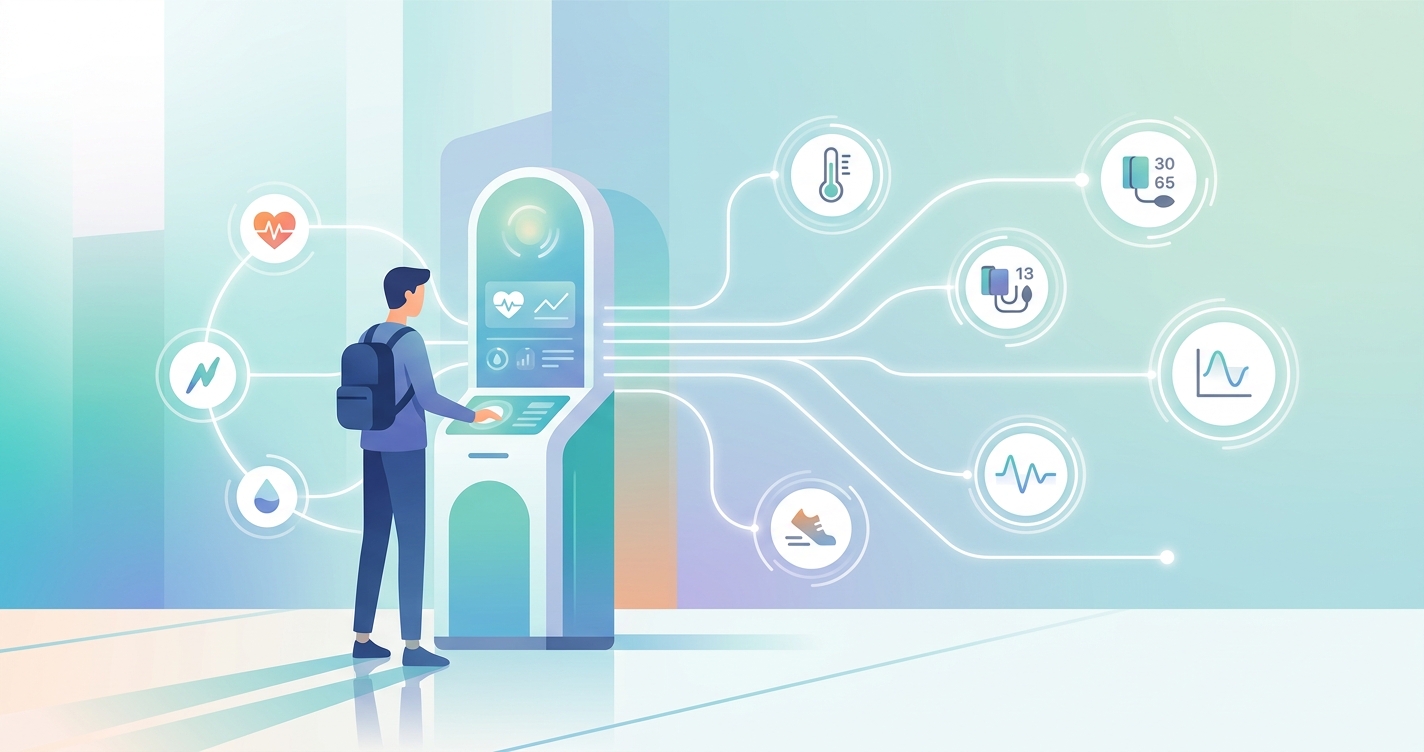
The seemingly instantaneous measurement of your vital signs by a health kiosk in a pharmacy or clinic is a remarkable example of specialized engineering. While it feels like magic, it's the result of a sophisticated, non-contact technology known as remote photoplethysmography (rPPG), which has been custom-trained for the specific hardware and environment of that kiosk. This isn't a general-purpose camera; it's a highly optimized system designed for a single purpose: to get an accurate reading from a person standing in a specific spot, under predictable lighting conditions.
"The key to rPPG is detecting the minuscule changes in skin color caused by blood flow. Our early research demonstrated that the green channel of a standard digital camera provides the strongest signal, corresponding to the absorption of light by oxyhemoglobin in the blood." - Wim Verkruysse, Beckman Laser Institute, University of California, Irvine (2008)
The science of fixed-camera vital signs
The core technology, rPPG, works by using a camera to detect subtle, imperceptible changes in the light reflected from a person's skin. As your heart pumps, the volume of blood in the vessels of your face fluctuates, causing tiny changes in skin color. A standard camera, when paired with advanced signal processing and a machine learning model, can translate these color changes into a waveform that is functionally similar to a traditional contact pulse oximeter.
However, the real-world environment of a retail pharmacy presents numerous challenges. People move, lighting conditions change, and there is a wide diversity of skin tones. For a pharmacy kiosk camera vital signs system to work reliably, it must be specifically designed to overcome these variables. Unlike a general-purpose smartphone app that has to work with thousands of different phone models in countless environments, a kiosk system has the advantage of a fixed, known environment. This allows hardware OEMs and device makers to train a custom rPPG model that is highly optimized for its specific operational context.
| Feature | General-Purpose rPPG (e.g., Smartphone App) | Custom Kiosk rPPG Model |
|---|---|---|
| Camera Hardware | Variable; must work on many different phone cameras | Fixed and known; model is trained on the specific sensor |
| Lighting Conditions | Uncontrolled and highly variable (indoor, outdoor, low light) | Controlled; kiosk has its own consistent light source |
| User Distance & Angle | Variable; user can be at any distance or angle | Fixed; user is instructed to stand in a specific location |
| Motion Tolerance | Low; high susceptibility to head and body movement | High; model trained with datasets of minor user movements |
| Processing | On-device, limited by phone's processor | Can utilize more powerful embedded hardware |
This level of customization is what makes the process so fast and seemingly effortless for the user. The system isn't trying to solve a generalized problem; it's solving a very specific one with a tool built expressly for that task.
- The model knows the exact specifications of the camera sensor.
- It is calibrated for the kiosk's built-in, consistent lighting.
- It anticipates the user's distance and position.
- The algorithm is trained to filter out the "noise" of minor movements.
Industry Applications
The technology behind the pharmacy kiosk is not limited to that single use case. Hardware OEMs and medical device manufacturers are increasingly integrating custom-trained, camera-based vital signs monitoring into a range of products.
Point-of-care and clinical settings
Beyond the pharmacy, these kiosks are being deployed in hospital waiting rooms, corporate wellness centers, and gyms. They serve as a rapid, non-invasive triage tool, allowing for quick health screening without the need for staff to apply contact sensors.
Smart home and iot devices
The same principles are being applied to smart mirrors and other in-home devices. A mirror that can check your heart rate and respiratory rate while you brush your teeth uses a similar fixed-camera rPPG model, trained for the specific lighting and distance characteristics of a bathroom environment.
Automotive driver monitoring
Car manufacturers are using inward-facing cameras to monitor driver alertness and health. A custom rPPG model, trained on the specific infrared (IR) or RGB camera installed in the dashboard or rearview mirror, can detect signs of drowsiness or cardiac distress, enhancing vehicle safety.
Current research and evidence
The field of remote vital signs monitoring is the subject of extensive academic and commercial research. Early foundational work, such as the 2008 study by Wim Verkruysse and his colleagues at the University of California, Irvine, established that standard cameras could extraherate physiological signals from video. Modern research focuses on improving the robustness of these systems against challenges like motion and variable lighting.
Recent studies have utilized deep learning, particularly convolutional neural networks (CNNs) and transformer models, to more effectively separate the subtle blood-volume pulse signal from motion artifacts and lighting noise. Researchers at institutions like the Eindhoven University of Technology have published work on advanced signal processing techniques such as CHROM and POS, which are designed to isolate the rPPG signal in real-time video streams. The development of large, diverse datasets, featuring thousands of individuals under various conditions, is critical for training the robust AI models required for pharmacy kiosk camera vital signs applications.
The future of contactless sensing
The rapid measurement you experience at the pharmacy kiosk is just the beginning. As camera sensors become more sophisticated and machine learning models become more efficient, contactless vital signs monitoring will be integrated into more aspects of daily life. The future will see this technology embedded in everything from neonatal incubators to long-haul flight seats, providing a continuous and frictionless stream of health data. The key to this expansion is the ability to move beyond one-size-fits-all software and develop custom models that are precisely tuned to the specific camera hardware and operating environment of each unique application.
Frequently asked questions
Q: Is the camera in the kiosk recording me? A: The camera is processing the video stream in real-time to extract physiological data. For privacy and data security, these systems typically do not store the video footage. The processing happens on the device, and only the final vital sign measurements are recorded.
Q: How accurate are these camera-based measurements? A: When a system is properly calibrated for its specific hardware and environment, the accuracy can be very high, often approaching the performance of traditional contact-based medical devices. However, accuracy depends heavily on this custom training and the quality of the sensor.
Q: Can this technology work in the dark? A: Yes. Many systems are designed to work with infrared (IR) cameras, which do not require visible light. These are often used in automotive driver monitoring systems and for low-light environments like a baby's nursery.
Q: Why can't my phone do this as quickly? A: While some phone apps can measure vitals, they are using a general-purpose model that must work on many different phone cameras in unpredictable lighting. A pharmacy kiosk uses a custom-trained model optimized for a single, known camera and a controlled environment, which leads to a much faster and more reliable measurement.
The proliferation of cameras in our environment presents a massive opportunity for passive health sensing. Circadify specializes in building the custom rPPG models that power these next-generation devices, ensuring that hardware OEMs and device makers can achieve the highest level of accuracy and performance from their specific camera hardware. To learn more about commissioning a custom-trained model for your clinical kiosk or medical device, visit our custom build inquiry page at circadify.com/custom-builds.