What Is Domain Adaptation for rPPG? Retraining for New Environments
Learn why rPPG models fail in new environments and how domain adaptation and retraining strategies can ensure model accuracy across different cameras, lighting, and populations.
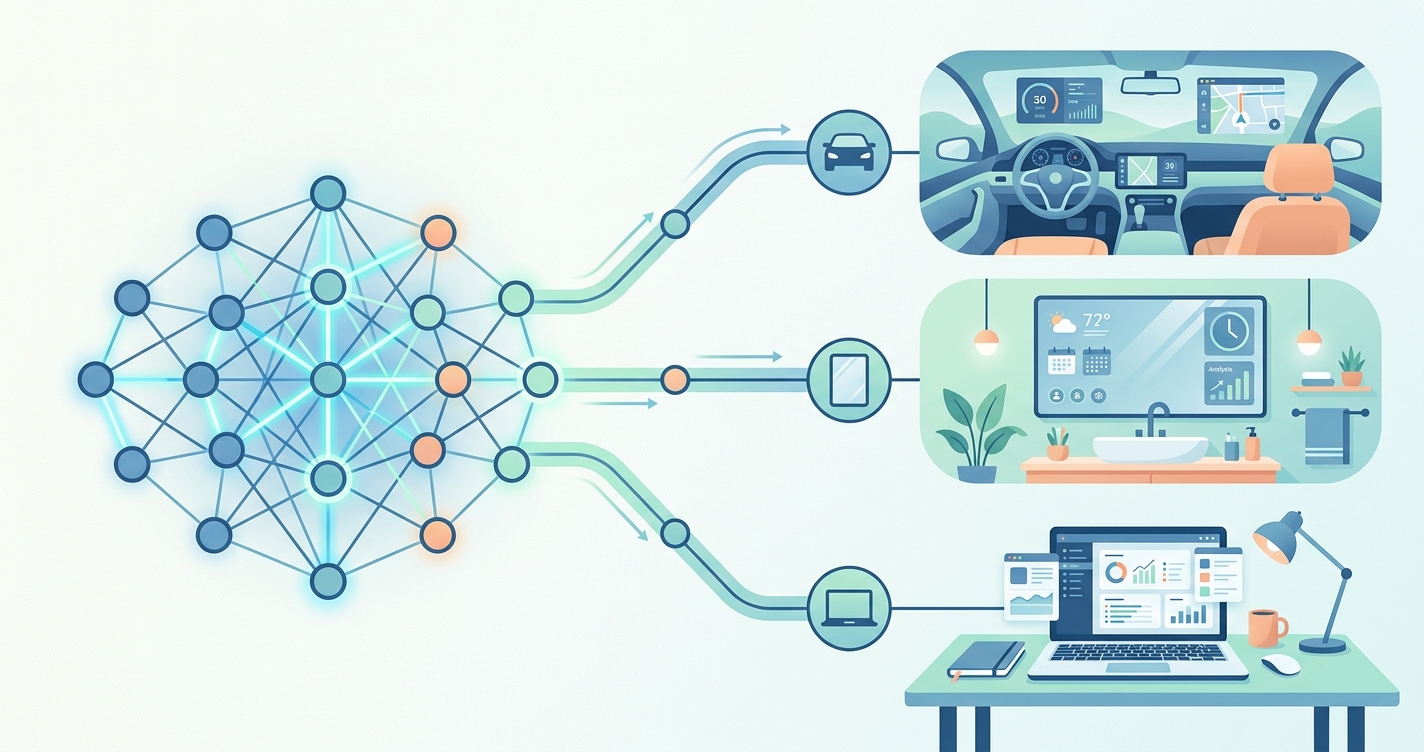
A remote photoplethysmography (rPPG) model that performs with high accuracy in a controlled lab setting can see its performance collapse when deployed to a new environment. For hardware OEMs and device makers, this is a critical challenge. The transition from a lab-grade camera to an automotive-grade IR sensor or a consumer-grade webcam introduces a "domain shift" that can render a pre-trained model unreliable. The core issue is that the new camera, lighting, and user population represent a new data distribution that the original model was not trained on. Addressing this requires a specific strategy: domain adaptation rppg retraining new environments to ensure continued accuracy and performance.
"In cross-dataset evaluations, we see a significant performance drop. For example, the Mean Absolute Error (MAE) can increase from less than 3 beats per minute (bpm) on a source dataset to over 13 bpm on a target dataset, representing a performance degradation of over 300%." (Summarized from research by Gideon V. et al., 2021)
The Challenge of Domain Shift in rPPG
An rPPG model's performance is intrinsically tied to the characteristics of the data it was trained on. When the "domain" or operational environment changes, the model's underlying assumptions no longer hold true. This domain shift is the single biggest threat to the scalability and reliability of rPPG deployments in the wild. Key factors that define a domain and contribute to performance degradation include camera and sensor properties, ambient lighting conditions, and subject-related variables.
- Camera and Sensor Differences: The most significant source of domain shift is hardware variance. A model trained on data from a high-resolution, visible-light CMOS sensor will struggle when deployed on a device using a lower-resolution NIR (near-infrared) camera, common in automotive driver monitoring systems. Sensor characteristics like quantum efficiency, color filter array, compression artifacts, and lens distortion all create unique data signatures.
- Illumination Variability: The rPPG signal is extracted from subtle changes in skin reflectance, a measurement that is highly sensitive to ambient light. A model trained under stable, fluorescent lab lighting may fail when exposed to the dynamic, broad-spectrum lighting of a moving vehicle, with its rapid shifts in intensity and color temperature caused by shadows, tunnels, and weather.
- Population and Motion Diversity: Subject-specific factors also create domain shifts. Skin tone, age, and physiology affect the optical properties of the skin. Likewise, motion artifacts, from head movements to vibrations in a vehicle, introduce noise that can be unique to the use case. A model trained on a dataset of stationary subjects with limited demographic diversity will not generalize well to a real-world, heterogeneous population.
Successfully deploying rPPG technology requires a robust strategy for domain adaptation rppg retraining new environments, moving beyond the one-size-fits-all model paradigm.
| Adaptation Strategy | Data Requirement (Target Domain) | Computational Cost | Performance Gain | Key Disadvantage |
|---|---|---|---|---|
| No Adaptation | None | None | None | Very high error rates; model is unreliable. |
| Full Retraining | Large labeled dataset | Very High | High | Impractical and expensive to collect new labeled data for every new environment. |
| Fine-Tuning | Small labeled dataset | Medium | Medium-High | Still requires labeled data, which is often the bottleneck. |
| Unsupervised Domain Adaptation (UDA) | Unlabeled dataset | Medium-High | Medium-High | Relies on aligning distributions, can be less precise than supervised methods. |
| Source-Free Domain Adaptation (SFDA) | Unlabeled dataset | Medium | Medium | Adapts model using only target data, protecting source model IP and data privacy. |
Industry Applications
For hardware OEMs, domain adaptation is not an academic exercise but a product-level necessity. The chosen strategy directly impacts system cost, development time, and end-user performance.
Automotive driver monitoring systems
Automotive interiors are one of the most challenging environments for rPPG. Lighting changes constantly, from day to night to tunnels. Drivers have different skin tones, and their faces are often partially occluded or in shadow. A model trained on a general dataset will fail. Unsupervised domain adaptation is critical here, allowing an in-car system to adapt the rPPG model to the specific lighting and driver without needing personal data sent to the cloud.
Smart mirrors and wellness devices
Manufacturers of smart mirrors or other at-home wellness products face a different challenge: camera variability. While the environment is relatively stable, the OEM may source cameras from multiple vendors over the product's lifecycle. Domain adaptation techniques allow the manufacturer to deploy a base rPPG model and then fine-tune it for each new camera batch without a full-scale data collection and retraining effort.
Clinical and telehealth kiosks
In telehealth, a patient may use their own device's webcam. This creates a massive domain shift problem, as the model must work on hundreds of different phone and laptop cameras. Source-Free Domain Adaptation (SFDA) is a promising approach in this scenario, where a model can be adapted on the user's device to their specific camera without the original training data ever leaving the developer's servers.
Current research and evidence
The field of computer vision has produced several powerful techniques for domain adaptation, which are now being applied to rPPG. The primary goal is to learn domain-invariant features, allowing the model to focus on the underlying physiological signal rather than the environmental noise.
Much of the foundational research, such as the work on Domain-Adversarial Neural Networks (DANN) by Ganin et al. (2016), involves training a model to perform the primary task (predicting the PPG signal) while simultaneously training it to not be able to distinguish between the source and target domains. This forces the model to learn features that are common to both environments.
More recently, researchers have focused on methods that do not require access to the original source data during adaptation, a field known as Source-Free Domain Adaptation (SFDA). A 2023 study by a team at the University of Oulu explored the use of spatio-temporal consistency as a supervisory signal, allowing a source model to be adapted for a new domain using only unlabeled target video. This is particularly valuable for commercial applications where the original training data is proprietary or contains sensitive information.
Another key area is Continual Test-Time Adaptation (TTA), where the model adapts itself continuously as it encounters new data. A 2022 paper on this topic demonstrated a framework that can handle dynamic shifts in a sequence of different domains, for example, adapting from a lab to a car, and then to a low-light environment, without "catastrophic forgetting" of the knowledge from previous domains.
The future of rPPG adaptation
The trajectory of rPPG development is moving towards models that are not just accurate, but robust and adaptable. The future lies in creating systems that can be deployed into an unknown environment and either work out-of-the-box or quickly adapt with minimal data. This will involve a combination of techniques:
- Hybrid Approaches: Combining unsupervised learning on unlabeled data with supervised fine-tuning on a very small set of labeled data from the new environment to achieve the best balance of cost and performance.
- On-Device Adaptation: Running adaptation algorithms directly on edge devices like automotive ECUs or smart-home hubs. This preserves user privacy and enables real-time responsiveness to changing conditions.
- Generative Models: Using generative AI to create synthetic data that simulates the target domain. This could allow a model to be "pre-adapted" for a new camera or lighting environment before it is ever deployed.
Ultimately, solving the domain shift problem is a prerequisite for the mass-market adoption of rPPG technology. For hardware manufacturers and Tier-1 suppliers, partnering with specialists who understand the nuances of model training and adaptation will be key to delivering reliable products.
Frequently asked questions
What is a "domain" in the context of rPPG? A domain refers to the specific environment and conditions under which rPPG data is collected. This includes the camera sensor type, lighting conditions, subject demographics, and motion patterns. A model trained in one domain may not work well in another.
Why can't a single rPPG model work for all cameras? Different cameras have unique hardware characteristics, such as their sensor type (CMOS, IR), lens, and internal image processing pipeline. These differences change how the camera "sees" the subtle color changes in the skin used to derive the rPPG signal, requiring the model to be adapted.
What is the difference between full retraining and domain adaptation? Full retraining involves collecting a large, labeled dataset from the new environment and training a model from scratch, which is slow and expensive. Domain adaptation uses techniques to adapt an existing, pre-trained model to the new environment using much less data (often unlabeled).
Is domain adaptation the same as transfer learning? They are related concepts. Transfer learning is a broader term for taking knowledge from one task and applying it to another. Domain adaptation is a specific type of transfer learning focused on adapting a model to a new data distribution or environment while keeping the task the same.
The challenge of deploying robust and accurate rPPG systems across a wide range of real-world hardware is significant. Overcoming the performance drop from domain shift is a critical step in moving this technology from the lab to production. Circadify is actively addressing this space by developing advanced methods for creating and adapting custom-trained models for specific camera hardware and use cases. To explore a custom rPPG model build for your device, learn more at our custom build inquiry page.