Can a simple webcam really track my breathing without any special sensors?
A technical look at whether a standard webcam can serve as a breathing tracker, the accuracy limits, and what it means for OEM and IoT device integration.
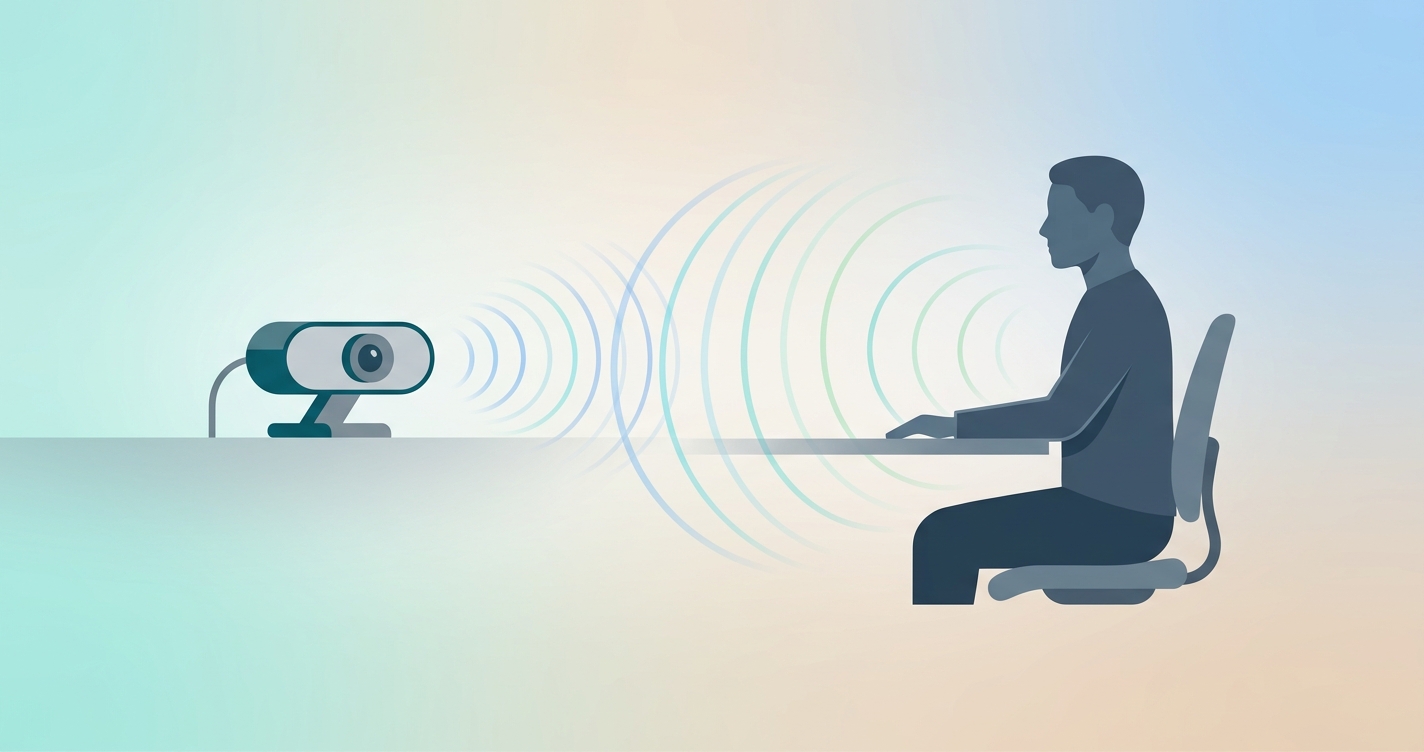
The question sounds almost too good to be true: can a $20 plastic webcam, the same one used for video calls, quietly measure how fast someone is breathing? For product teams evaluating contactless sensing, this is not idle curiosity. It determines whether respiratory monitoring can be added to an existing device through software alone, or whether it demands new sensors, new bill-of-materials cost, and a longer certification path. The short answer is that a standard webcam can function as a credible webcam breathing tracker for respiratory rate under controlled conditions, but the gap between a research demo and a robust shipping feature is where most of the engineering work actually lives.
A robust single-webcam method for breath rate measurement reported an average mean absolute error of 0.57 respirations per minute, with relative deviation from clinical ground truth under 5 percent, demonstrating that consumer-grade optics carry usable respiratory information.
How a webcam breathing tracker actually works
A camera never sees breath directly. It infers respiration from two physical signals, and a well-designed system usually fuses both.
The first is motion. As the chest and shoulders rise and fall, pixels in those regions shift in a slow, periodic pattern. Optical flow, frame differencing, or landmark tracking can extract this rhythm, typically in the 0.1 to 0.7 Hz band that corresponds to 6 to 42 breaths per minute.
The second is remote photoplethysmography, or rPPG. The same micro-changes in skin reflectance that reveal heart rate also carry a respiratory component, because breathing modulates blood volume, pulse amplitude, and pulse timing. This is the mechanism documented by Ming-Zher Poh, Daniel McDuff, and Rosalind Picard at MIT in their 2010 Biomedical Optics Express paper, which showed a webcam could recover both pulse and respiration from facial video. Respiratory rate is then estimated from amplitude or frequency modulation of the extracted pulse signal.
A webcam breathing tracker built for production rarely relies on a single path. Motion is strong when the torso is visible and still; rPPG-derived respiration is useful when only the face is in frame, such as a laptop or kiosk camera. Combining them improves resilience when one source degrades.
The hard part is that breathing is a low-frequency, low-amplitude signal sitting underneath much larger noise sources: posture shifts, talking, ambient light flicker, automatic camera gain, and compression artifacts. Separating a 0.25 Hz breathing rhythm from a subject who leans forward to read their screen is a signal processing and modeling problem, not a sensor problem.
Accuracy: what the evidence actually shows
Recent peer-reviewed work gives a reasonably consistent picture. Under cooperative conditions, camera-based respiratory rate lands within roughly 1 breath per minute of contact references. Performance degrades predictably as motion, distance, and lighting get worse.
| Approach | Hardware | Reported error | Typical conditions |
|---|---|---|---|
| Single-webcam breath rate (motion + signal fusion) | Consumer RGB webcam | ~0.57 rpm MAE, <5% deviation | Seated, cooperative subject |
| Informative-frame extraction in ICU | Fixed RGB camera | ~0.21 bpm MAE across 25 patients | Clinical, non-breathing motion removed |
| rPPG-derived respiration (facial video) | Webcam | ~1 to 2 bpm typical | Face visible, low motion |
| Thermal deep-learning model | LWIR thermal camera | ~1.6 bpm | Variable, robust to darkness |
| Infant respiration (NICU) | RGB camera | ICC 0.91 / 0.88 reliability | Monitored crib, controlled framing |
A few patterns are worth drawing out for anyone scoping a feature:
- The best published numbers come from setups that aggressively reject bad data. The ICU 0.21 bpm result depended on detecting and discarding frames contaminated by non-respiratory motion. Accuracy is partly a function of knowing when not to report.
- Respiratory rate is achievable on commodity RGB. Tidal volume, breathing effort, and apnea classification are substantially harder and far less validated.
- Thermal and near-infrared sensors trade resolution for independence from visible lighting, which matters for automotive and bedside use where darkness is the norm.
Industry applications and the integration reality
The reason a webcam breathing tracker matters commercially is that the camera is often already in the product. The marginal cost of adding respiration is a model and some compute, not a new module.
Automotive and driver monitoring
Cabin-facing cameras mandated for driver monitoring already capture the face and upper torso, usually under near-infrared illumination. Respiratory rate and breathing irregularity add a layer to drowsiness and impairment detection. The constraints are severe though: vibration, seatbelt occlusion, sunglasses, and rapidly changing light. An NIR cabin sensor behaves nothing like a desk webcam, which is why a generic model tuned on RGB laptop footage tends to collapse in the car.
Telehealth and clinical kiosks
Video-visit platforms and point-of-care kiosks can surface respiratory rate passively while a patient sits for an exam. Here the camera varies wildly between the clinician laptop, the kiosk module, and the patient device, so a tracker has to either generalize broadly or be matched to a known camera.
IoT, smart home, and infant monitoring
Smart displays, mirrors, and baby monitors all hold a fixed camera pointed at a fairly predictable scene. Fixed framing is a gift for breathing estimation, which is why the NICU and crib results are among the strongest in the literature. The catch is that low-cost IoT sensors push noisy, heavily compressed video that erodes the subtle signal.
The throughline across all three is that the camera, not the algorithm, defines the ceiling. Sensor type, resolution, frame rate stability, rolling-shutter behavior, auto-exposure logic, and codec all shape what respiratory information survives to the model. A breathing tracker validated on one camera frequently underperforms on another that looks similar on paper.
Current research and evidence
The field has matured from single-lab proofs to systematic evaluation. A growing body of work, including systematic reviews of contactless respiratory measurement using RGB cameras, now treats camera-based respiration as a measurable quantity with defined error bars rather than a novelty.
Three threads stand out. First, data quality gating: the strongest clinical results, such as the 0.21 bpm ICU figure from informative-frame extraction work at Eindhoven University of Technology, came from explicitly removing corrupted segments before estimating rate. Second, modality expansion: thermal deep-learning models reaching roughly 1.6 bpm error show that respiration survives even when visible light does not, which is decisive for night and in-cabin use. Third, population specificity: infant respiration models report high reliability precisely because they are trained on infant physiology and framing rather than borrowed from adult datasets.
The recurring lesson is that headline accuracy is conditional. The same method that hits sub-1 bpm on a seated adult in good light can drift to several bpm on a moving subject, at distance, or on a different camera. Reported numbers are a property of the camera, the population, and the operating envelope together, not of the algorithm in isolation.
The future of webcam-based breathing tracking
The trajectory points toward respiration becoming a standard passive output of any product that already has a camera, in the same way heart rate quietly arrived on wrist wearables. Three shifts will drive that.
Edge deployment is one. As lightweight temporal models run on device NPUs, breathing estimation stops requiring a cloud round trip, which helps both latency and privacy. Multimodal fusion is another: combining rPPG, motion, and depth or thermal cues yields estimates that survive real-world conditions far better than any single channel. The third, and most consequential for hardware teams, is camera-specific modeling. The clearest finding across the literature is that a model tuned to a particular sensor, lens, illumination, and use case outperforms a one-size-fits-all model by a wide margin.
That last point reframes the original question. A simple webcam really can track breathing. Whether your device can depends on whether the model has been trained for your camera and the conditions it will face.
Frequently asked questions
Can a regular webcam measure breathing without any special sensor? Yes, for respiratory rate. A standard RGB webcam carries both chest-motion and rPPG-based respiratory signals, and published methods report errors near 0.5 to 2 breaths per minute under cooperative, well-lit, seated conditions. No dedicated respiration sensor is required, though accuracy depends heavily on lighting, motion, and the specific camera.
How accurate is a webcam breathing tracker compared to a contact monitor? In controlled settings, camera-based respiratory rate has reported mean absolute errors below 1 breath per minute, with one single-webcam method at roughly 0.57 rpm and an ICU pipeline at about 0.21 bpm after rejecting bad frames. Accuracy falls with movement, distance, poor light, and aggressive video compression, so real-world performance is usually wider than lab numbers.
Can a camera detect more than respiratory rate, like breathing depth or apnea? Respiratory rate is the most reliable output today. Tidal volume, breathing effort, and apnea detection are active research areas but are far less validated on consumer cameras and typically need controlled framing, higher quality sensors, or additional modalities such as depth or thermal imaging.
Why does the same breathing algorithm work on one camera but fail on another? Because the camera defines the ceiling. Sensor type, resolution, frame-rate stability, rolling shutter, auto-exposure behavior, and codec all change how much of the subtle respiratory signal survives. A model trained on one camera often underperforms on a different one, which is why camera-specific training matters.
Camera-based respiration is now well past proof of concept, but the distance between a research result and a feature that holds up across your hardware, your users, and your operating environment is exactly where most projects stall. That gap is the problem Circadify is built to close, with rPPG and respiration models trained for a specific camera, sensor, and use case rather than a generic average. Teams scoping a contactless breathing feature can start a custom build conversation at circadify.com/custom-builds.