Can my security camera tell if someone is unwell in their home all day?
A technical look at security camera health monitoring: can existing home cameras passively sense vitals, and what OEMs need to build IoT health sensing models.
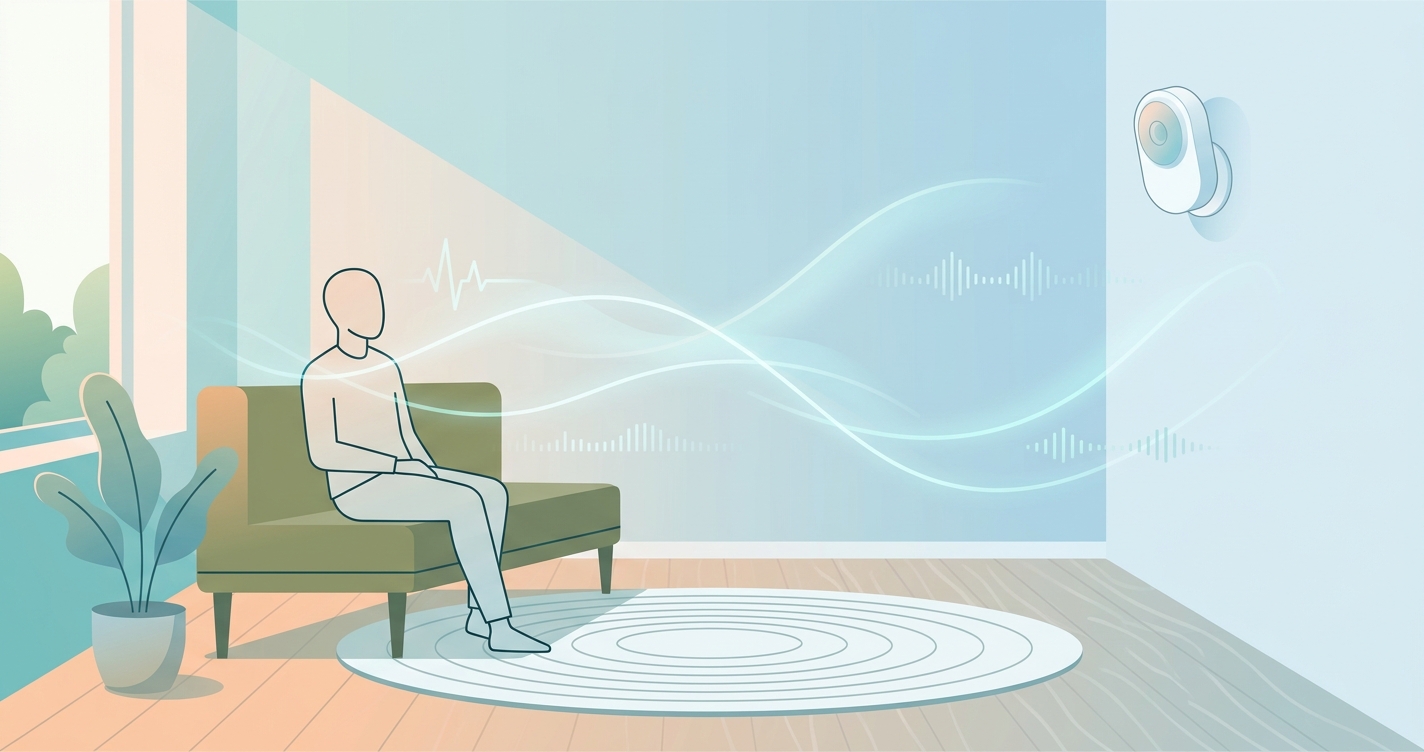
The cameras already mounted in millions of living rooms, hallways, and entryways were designed to watch for intruders. A growing question among device makers is whether that same hardware could also notice when a resident is becoming unwell, hours before anyone calls for help. Security camera health monitoring sits at the intersection of two mature markets, home surveillance and remote patient care, and the technical premise is reasonable: a camera that can resolve a face well enough for recognition is capturing the same pixels that contain a faint cardiac and respiratory signal. The harder question for hardware OEMs and IoT device makers is whether a general-purpose security sensor can extract that signal reliably enough to be worth shipping.
A 2024 systematic review of non-contact vision-based vital sign monitoring published in MDPI Sensors found that camera-based remote photoplethysmography can estimate heart rate within a few beats per minute of contact reference devices under controlled conditions, but accuracy degrades sharply with motion, distance, and uncontrolled lighting, the exact conditions a home security camera operates in every day.
What security camera health monitoring actually measures
The underlying method is remote photoplethysmography (rPPG). Each heartbeat pushes a pulse of blood through the capillaries near the skin surface, changing how much light the skin absorbs and reflects. A camera records these changes as tiny fluctuations in pixel intensity, far too small for a human to see, that an algorithm can isolate into a pulse waveform. From that waveform a model can estimate heart rate, heart rate variability, and respiration rate, and in research settings researchers are extending the same approach toward blood oxygenation and blood pressure trends.
For a security camera, the appeal is that no new sensor is required. The same frames feeding motion detection could, in principle, feed a vitals model. But security cameras were never specified for this task, and that mismatch is where most projects stall. A continuous monitoring scenario, watching whether someone is unwell across an entire day, is fundamentally different from a 30-second face scan at a kiosk. The subject moves freely, walks in and out of frame, sits in shadow, faces away from the lens, and is recorded under lighting that swings from morning sun to a single lamp at night.
Several hardware realities separate a security feed from a clean rPPG source:
- Compression. Most security cameras apply aggressive H.264 or H.265 compression that discards the subtle inter-frame color changes rPPG depends on.
- Distance and resolution. A ceiling or corner camera may capture a face across only a small fraction of the frame, leaving few usable skin pixels.
- Frame rate stability. Variable or low frame rates distort the timing information a pulse estimate relies on.
- Sensor type. Many cameras switch to infrared night mode after dark, which changes the entire physics of the signal.
- Auto-exposure and white balance. Automatic gain control constantly readjusts pixel values, injecting noise that mimics or masks the cardiac signal.
How camera types compare for passive home sensing
No single camera class is ideal for all-day health sensing. The table below compares the configurations a device maker is likely to encounter when evaluating an existing fleet or specifying a new product.
| Camera type | Typical placement | rPPG signal quality | Day/night coverage | Practical challenge for health sensing |
|---|---|---|---|---|
| RGB security camera | Corner, ceiling, doorway | Moderate when subject is close and lit | Poor without supplemental lighting | Heavy compression and long range reduce usable skin pixels |
| IR / near-infrared night camera | Bedrooms, hallways | Low to moderate, narrowband | Strong in darkness | Requires a model trained on IR reflectance, not RGB |
| Wide-angle / fisheye | Open-plan rooms | Low at frame edges | Varies | Lens distortion warps the face region of interest |
| Fixed indoor smart camera | Living room, kitchen | Moderate to good at short range | Moderate | Auto-exposure noise unless tuned for stable capture |
| Doorbell / entry camera | Entryway | Low, brief exposure | Moderate | Subjects pass through too quickly for stable estimates |
The pattern across these options is consistent: the camera that gives the best surveillance coverage is rarely the one that gives the best vitals signal, and a model trained on one sensor profile does not transfer cleanly to another.
Industry applications driving the interest
Aging in place and senior living
The strongest commercial pull comes from independent living for older adults. A 2024 study by Italian National Research Council (CNR) researchers on camera-based photoplethysmography in elderly subjects highlighted that skin changes such as wrinkles, moles, and reduced perfusion add real difficulty to vitals estimation in this exact population, the one most likely to benefit. The vision is a camera that flags a sustained change, an elevated resting heart rate over several days, an irregular respiration pattern, or reduced movement, and alerts a caregiver before a crisis. Crucially, this is trend detection across a day, not a diagnostic single reading.
Telehealth and remote patient programs
Care providers running remote monitoring programs want passive data that does not depend on a patient remembering to use a cuff or wear a band. A camera already present in the home lowers that adherence barrier. The constraint is that such systems must communicate clearly that they provide wellness signals and trends, not clinical diagnoses.
Smart home and security platform expansion
Home security brands are looking for recurring-value features beyond intrusion alerts. A presence-and-wellbeing layer, is the resident moving normally, breathing normally, turns an existing subscription camera into a health-adjacent device without new hardware sales.
Current research and evidence
The peer-reviewed picture supports cautious optimism rather than plug-and-play readiness. The 2024 MDPI Sensors systematic review on non-contact vision-based monitoring concluded that heart rate estimation is the most mature output, respiration is achievable, and blood pressure and SpO2 remain active research targets with wider error margins. A separate PMC systematic review on continuous monitoring of vital signs using cameras emphasized that nearly all strong results come from constrained settings with cooperative subjects, controlled lighting, and short distances.
A 2025 current survey of rPPG for contactless health sensing, led by Shadman Sakib and colleagues, pointed to deep learning models as the main route to robustness, while noting that these models are highly sensitive to the camera and conditions they were trained on. That sensitivity is the central engineering message for anyone building security camera health monitoring: generic rPPG software validated on webcam datasets will not perform the same on a compressed, wide-angle, IR-switching security feed. The signal physics, noise profile, and region-of-interest behavior are different, so the model has to be trained or adapted for the specific sensor and deployment.
This is also why distance and motion keep appearing as limiting factors. A webcam study cited across the literature shows good cardiac estimation at arm's length with a still subject; a hallway camera capturing a person walking past at three meters is a far harder problem that demands camera-specific tuning rather than a one-size-fits-all algorithm.
The future of security camera health monitoring
The realistic trajectory is incremental. Near term, expect passive heart rate and respiration trend estimation in cameras positioned where people sit still for a while, a reading chair, a bedside, a kitchen table, rather than reliable all-day coverage from a single corner-mounted lens. Multi-camera fusion, where several sensors in a home each contribute partial readings, is a plausible path to genuine day-long monitoring, since it removes the dependence on any one favorable viewing moment.
Two hardware trends will accelerate this. First, edge processing on camera SoCs lets vitals inference run on-device, addressing the privacy concern that holds back camera-based health features and reducing the compression problem by analyzing frames before they are encoded for storage. Second, IR and thermal sensing is becoming standard in security cameras, which makes night-time sensing feasible but only with models built for those wavelengths rather than ported from RGB.
The differentiator will not be whether a camera can run a vitals model, but whether that model was matched to the camera. A custom-trained, camera-specific approach, one that accounts for the sensor, the lens, the compression pipeline, and the realistic viewing geometry of a home, is what separates a demo from a shippable IoT health sensing feature.
Frequently asked questions
Can a standard security camera measure vital signs without any new hardware? In favorable conditions, an existing camera can capture enough signal to estimate heart rate and respiration when a person is close, still, and well lit. Reliable all-day monitoring across a whole room is much harder, and usually requires a model tuned to that specific camera and placement rather than off-the-shelf software.
Is this accurate enough to detect that someone is unwell? Camera-based methods are best understood as trend and wellness indicators, not clinical diagnostics. A sustained shift in resting heart rate, respiration, or activity over hours or days can be a useful early signal, but it should prompt a check rather than replace a medical measurement.
Why does night mode break health sensing? When a camera switches to infrared, the light interacting with the skin changes entirely. A model trained on visible-light color changes will not interpret IR reflectance correctly, so night-time sensing needs a model built specifically for the IR or thermal sensor.
What is the single biggest factor in making it work? Matching the model to the hardware. Compression, resolution, frame rate, sensor type, and viewing distance all shape the signal, so a model trained and validated on the exact camera and use case performs far better than a generic algorithm.
Circadify is working directly on this space, building custom rPPG and IoT health sensing models tuned to specific cameras, sensors, and deployment conditions rather than generic software dropped onto unmatched hardware. If you are evaluating whether your camera platform can support passive health sensing, you can start a custom build conversation at circadify.com/custom-builds.