How can my phone's camera instantly know my stress without touching me?
How phone camera stress detection works through rPPG and HRV, and why hardware OEMs face rising demand for embedded health monitoring AI in everyday devices.
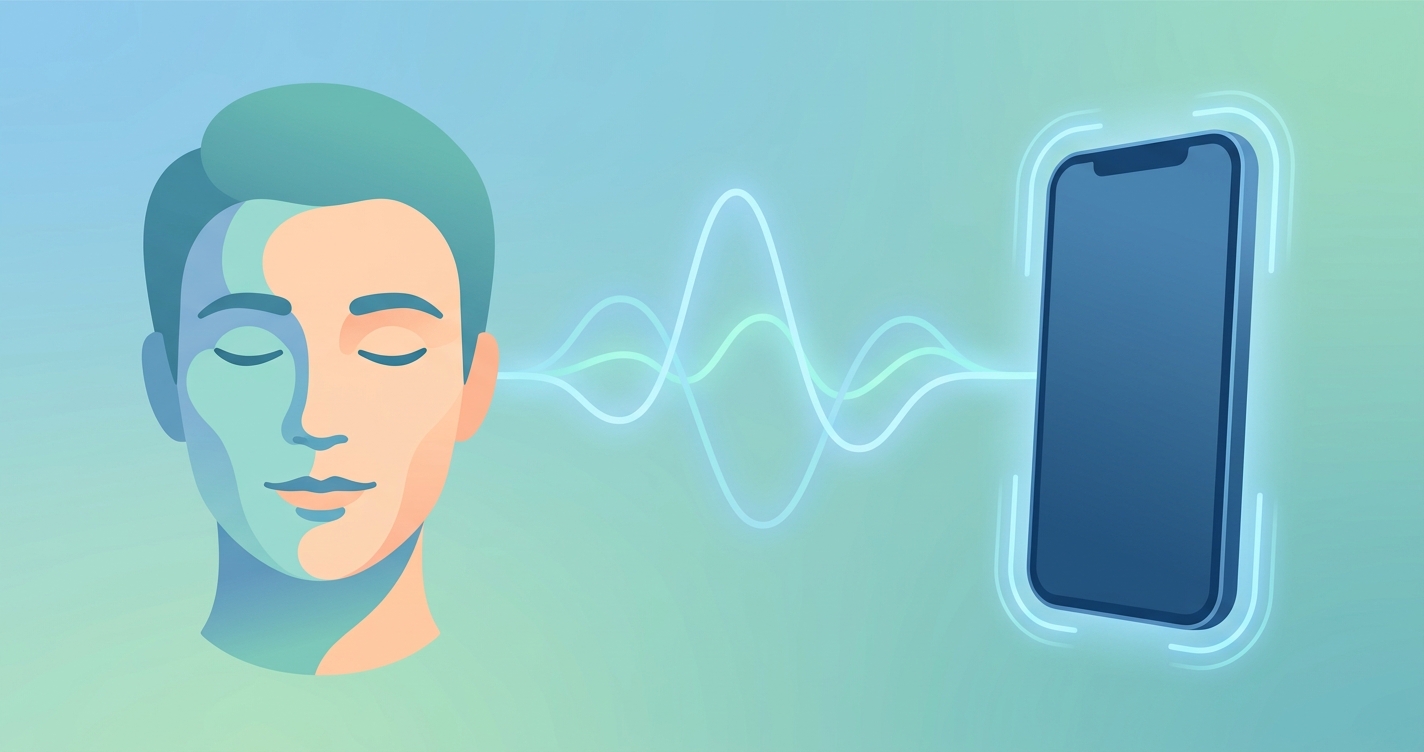
When a smartphone application reads your stress level by looking at your face for thirty seconds, it feels like sleight of hand. There is no cuff, no chest strap, no fingertip clip. Yet the underlying mechanism is well documented physics combined with machine learning. Phone camera stress detection works because skin is slightly translucent, and with every heartbeat a pulse of blood changes how much light your face reflects. A standard front camera captures those micro-fluctuations, and an algorithm reconstructs the pulse waveform, the spacing between beats, and the variability in that spacing that correlates with autonomic stress. For hardware OEMs, automotive Tier-1 suppliers, and IoT device makers, the more important story is not the magic trick but the consumer expectation it creates: people now assume that any device with a camera should be able to sense how they feel.
A 2023 validation study of a mobile phone photoplethysmography application reported "near perfect" correlation with ECG across multiple heart rate variability indices, signaling that camera and contact-light pulse sensing can reach research-grade agreement for HRV assessment under controlled conditions.
How phone camera stress detection actually works
Phone camera stress detection rests on remote photoplethysmography, or rPPG. A contact pulse oximeter shines light into the skin and measures absorption. An rPPG model does the same thing passively, inferring the blood volume pulse from subtle color shifts in facial video that are invisible to the human eye. The green channel of a standard RGB sensor carries most of the usable signal because hemoglobin absorbs green light strongly, though robust pipelines fuse multiple channels and regions of the face.
Stress is not measured directly. The camera estimates heart rate, then derives heart rate variability (HRV) from the tiny differences in time between consecutive beats. A relaxed parasympathetic state produces higher, more irregular variability. A stressed sympathetic state compresses and regularizes the intervals. Models map those HRV features to a stress index. This is why the quality of the beat-to-beat timing matters far more than the average heart rate alone. An algorithm can report a plausible pulse and still be useless for stress if its inter-beat interval timing is noisy.
The hard part is that the signal is faint. The color change tied to each heartbeat is often a fraction of a percent of pixel intensity, easily buried under motion, lighting flicker, compression artifacts, and skin tone variation. Recent research has pushed accuracy upward. A Google Research effort on passive heart rate monitoring, built on data collected between 2020 and 2024, reported a mean absolute percentage error under 10 percent for heart rate across skin tones in everyday smartphone use, outperforming 15 leading rPPG baselines. Separately, a study using the UBFC-Phys dataset reported stress classification accuracy up to 95.83 percent by combining rPPG features with deep learning. The caveat is real too: a 2025 analysis found rPPG accuracy can drop sharply at elevated heart rates, exactly the condition where stress monitoring matters most.
Camera and sensor approaches compared
No single camera is ideal for every deployment. The right choice depends on lighting, distance, motion, and whether the device must work at night. The table below summarizes how common sensor types behave for camera-based stress sensing.
| Sensor type | Pulse and HRV signal quality | Low-light performance | Best fit for OEMs | Main limitation |
|---|---|---|---|---|
| RGB front camera (smartphone, tablet) | Strong in good light | Weak without screen illumination | Phones, smart mirrors, kiosks | Sensitive to ambient lighting and motion |
| Near-infrared (NIR) | Moderate, narrower spectral signal | Strong, works in darkness | Automotive cabins, baby monitors | Lower blood-volume contrast than RGB |
| IR thermal | Indirect, via perfusion and respiration | Strong, independent of visible light | Driver monitoring, privacy-sensitive use | Coarse HRV resolution |
| Global-shutter machine vision | High, low motion distortion | Depends on illumination | Industrial and clinical fixed cameras | Cost and integration complexity |
A few patterns hold across deployments worth noting:
- Frame rate matters for HRV. Reliable inter-beat timing generally needs 30 frames per second or more, because stress features live in millisecond-scale interval differences.
- Skin tone fairness is an engineering requirement, not a nice-to-have. Models trained on narrow demographics degrade on darker skin where green-channel contrast is lower.
- Motion is the dominant error source in real products. A stationary user in a lab is not the same as a driver, a parent holding a phone, or someone walking.
- The camera that ships in the device defines the achievable accuracy. A model tuned for one sensor rarely transfers cleanly to another.
Industry applications driving embedded health monitoring AI
The contactless vital signs monitoring market was valued at roughly USD 1.3 billion in 2024, and analysts tracked an approximately 47 percent surge in AI integration within contactless monitoring systems from 2023 to 2024. That growth is pulling camera-based sensing into product categories far beyond the phone.
Automotive cabins
Driver monitoring is moving from optional to mandated under tightening safety protocols. Cabin cameras already track gaze and head pose, so adding stress and drowsiness estimation from the same NIR feed is a natural extension. The challenge is that automotive lighting changes constantly and the model must work before dawn and in tunnels, conditions where visible light disappears.
Smart mirrors and bathroom devices
A mirror sees a relatively still, well-lit face at a fixed distance for tens of seconds, an unusually favorable setup for HRV. This makes wellness mirrors a credible early venue for daily stress trends, provided the model is tuned for the specific module and lighting ring.
Wearable cameras and smart glasses
Inward or downward-facing cameras on glasses capture skin at close range but contend with constant micro-motion. These platforms benefit most from camera-specific models because the optics and field of view differ sharply from a phone.
IoT and home devices
Baby monitors, telehealth tablets, and clinical kiosks each present a distinct combination of sensor, distance, and population. A camera-specific vitals model trained for the exact hardware consistently outperforms a generic algorithm dropped onto unfamiliar optics.
Current research and evidence
The evidence base has matured from proof-of-concept to systematic benchmarking. The 2023 mobile phone PPG validation work demonstrated that consumer-grade pulse sensing can match ECG-derived HRV indices closely enough for biofeedback use. The Google Research passive monitoring program, drawing on data through 2024, showed that careful model design narrows the accuracy gap across skin tones rather than widening it, addressing one of the field's longstanding fairness concerns.
At the same time, independent 2025 work documenting accuracy loss at elevated heart rates is a useful corrective. It tells OEMs that headline benchmark numbers, often gathered on resting subjects, do not guarantee performance during the stress and exertion that products are meant to detect. The practical lesson is consistent across these studies: rPPG performance is conditional. It depends on the camera, the lighting, the motion profile, the population, and the operating heart rate range. A model validated on one dataset and one device should not be assumed to generalize. This is why deployment-specific validation against synchronized ground truth is becoming standard practice rather than an afterthought.
The future of phone camera stress detection
The trajectory points toward sensing that fades into the background of devices people already own. Three shifts are likely to define the next phase.
- On-device inference. Privacy expectations and latency requirements are pushing rPPG models onto the edge, running locally on phone, automotive, and IoT silicon rather than in the cloud.
- Multimodal fusion. Combining facial rPPG with voice prosody, facial expression, and motion sensors produces a more stable stress estimate than HRV alone, especially under movement.
- Hardware-specific optimization. As sensing spreads from phones to cars, mirrors, and glasses, the assumption that one universal model fits all cameras breaks down. The differentiator becomes a model trained for a particular sensor, lens, and use case.
For OEMs, consumer demand has already outrun the off-the-shelf toolkit. Buyers expect any camera-equipped product to offer some form of wellness sensing, but generic algorithms struggle the moment they meet real optics, real lighting, and real motion. The competitive question shifts from whether to add camera-based stress sensing to how to make it reliable on your specific hardware.
Frequently asked questions
Does phone camera stress detection actually measure stress, or just heart rate?
It measures pulse first, then derives heart rate variability from the timing between beats, and maps those HRV patterns to a stress estimate. Stress is inferred from autonomic nervous system signatures in the variability, not measured directly, which is why beat-to-beat timing accuracy is critical.
How accurate is camera-based HRV compared to a chest strap or ECG?
Under good conditions, validation studies have reported near-ECG agreement for several HRV indices. Accuracy falls with motion, poor lighting, darker skin tones if the model was not trained for them, and elevated heart rates, so real-world performance varies widely by device and context.
Why can't one rPPG model work across every camera?
Each camera has different optics, spectral response, frame rate, compression, and field of view. The blood-volume signal looks different on each sensor, so a model tuned for one device typically loses accuracy on another. Camera-specific training closes that gap.
What do OEMs need to deploy reliable camera-based stress sensing?
They need a model matched to their exact sensor and use case, validated against synchronized clinical-grade reference data under the lighting and motion conditions the product will face, including the higher heart rate ranges where generic models often fail.
Circadify is addressing this space directly by building custom-trained rPPG models optimized for a specific camera, sensor, and deployment rather than forcing a one-size-fits-all algorithm onto unfamiliar hardware. Teams evaluating embedded health monitoring AI for phones, vehicles, mirrors, or wearables can start a custom build inquiry at circadify.com/custom-builds.