
Can Smart Glasses Cameras Run Vitals Without Draining Battery?
How a low-power vitals model for smart glasses can run heart rate and respiration sensing on-device within tight milliwatt power budgets without killing battery life.
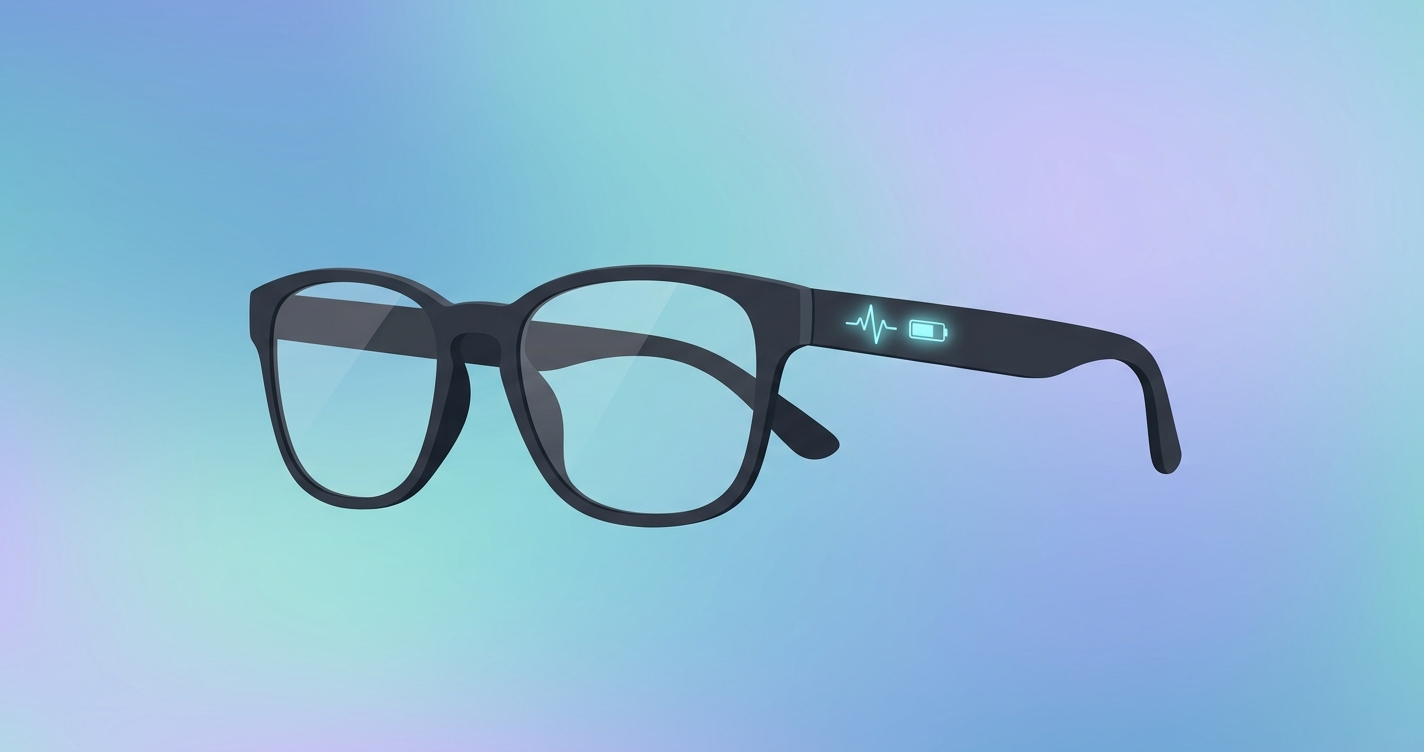
Smart glasses live or die by their power budget, and any health feature added to the temple has to justify every milliwatt it spends. The question facing hardware teams is direct: can the onboard camera measure heart rate and respiration without turning an all-day wearable into a two-hour novelty? The answer depends almost entirely on whether a low-power vitals model for smart glasses can be engineered to fit inside the narrow energy envelope that display, connectivity, and the host processor leave behind. Contactless sensing through remote photoplethysmography (rPPG) is attractive precisely because it reuses an existing camera, but the inference pipeline behind it is where the real power decisions are made.
"While some research targets an overall power consumption of 10 to 30 mW for AR smart glasses to meet ergonomic weight limits, practical operational modes with camera sensing and AR features typically draw significantly more power, ranging from 50 mA at idle to over 800 mA during high-intensity use.", synthesis of 2025 smart glasses power analyses
Why a low-power vitals model for smart glasses is a hard constraint
A wearable on the face cannot carry a large battery. The physics of comfort cap the cell at a few hundred milliamp-hours, and reviewers consistently find that display-equipped glasses deliver only two to four hours of continuous use, dropping toward an hour when camera and AI features run together. Within that reality, a low-power vitals model for smart glasses is not a software afterthought. It is a hardware co-design problem that decides whether vitals sensing is even shippable.
The encouraging signal from recent work is the size of the target. Continuous rPPG inference is being engineered toward sub-5 mW draw, which can add less than two percent to total device power when implemented carefully. Compare that to the display and the radio, which dominate the energy bill, and the vitals model stops looking like the villain. The catch is that hitting single-digit milliwatts requires aggressive quantization, duty-cycled sensing, and a model architecture matched to the specific image sensor and the periorbital or temple viewing angle, not a generic pipeline ported from a phone app.
The table below frames the trade-offs hardware teams weigh when budgeting power for embedded health monitoring AI.
| Sensing approach | Typical continuous power draw | On-device feasibility | Best fit for smart glasses |
|---|---|---|---|
| Cloud-offloaded rPPG inference | Low compute, high radio cost | Poor (latency, privacy, radio drain) | Rarely viable for always-on use |
| Generic full-precision rPPG model on-device | 50 to 200+ mW | Limited by thermal and battery | Short, on-demand spot checks |
| Quantized custom rPPG model on edge NPU/DSP | Sub-5 to 15 mW | Strong | Continuous or frequent sampling |
| Event-based or duty-cycled camera sensing | Single-digit mW or lower | Strong but algorithm-sensitive | Always-on background monitoring |
| Contact PPG sensor on nose pad | Low optical, variable LED cost | Strong | Complement, not camera replacement |
The pattern is clear: edge vitals model power use is governed less by the camera itself and more by how the model is compressed, scheduled, and mapped to silicon.
The levers that control edge vitals model power use
Power optimization for on-device vitals is a stack of decisions, each multiplying the savings of the one above it.
- Model quantization: moving from 32-bit floating point to 8-bit or lower integer math shrinks both memory bandwidth and compute energy, the two largest contributors to inference cost.
- Duty cycling: heart rate does not change meaningfully between every video frame, so sampling in short bursts rather than running every frame can cut average power dramatically.
- Hardware mapping: routing inference to a dedicated NPU or DSP inside the wearable system-on-chip is far more efficient than waking a general-purpose CPU core.
- Region-of-interest cropping: processing only the skin region in view, rather than the full sensor frame, reduces the pixels each inference pass must handle.
- Sensor selection: low-power photodetector designs and event-based cameras, which respond only to luminance changes, lower the cost of the always-on front end before the model even runs.
Each lever interacts with camera placement. Glasses see a narrow, oblique slice of facial skin, often the temple or the area around the eyes, which means the signal-to-noise profile differs from a forehead-facing kiosk or phone. A model tuned to that geometry can extract a clean pulse with fewer parameters, and fewer parameters mean less energy per inference.
Industry applications of wearable camera health sensing
Consumer health and wellness eyewear
For lifestyle smart glasses, the value is passive, background heart rate and respiration trends gathered without a chest strap or wrist device. Here the power constraint is absolute, because users judge the product against all-day battery expectations. Duty-cycled embedded health monitoring AI that wakes briefly each minute is usually the only path that survives a full day of wear.
Occupational safety and industrial eyewear
Safety glasses worn on a factory floor or by field crews can flag heat strain or fatigue through vital sign drift. These devices often tolerate slightly larger batteries and ruggedized frames, which loosens the power budget and allows more frequent sampling. The trade is that the camera may sit at an awkward angle relative to skin, raising the importance of a camera-specific model.
Clinical and telehealth eyewear
In assisted-living or remote-monitoring contexts, glasses can provide intermittent spot checks rather than continuous streams. Lower sampling frequency means the vitals model runs rarely, so even a heavier model can fit the energy budget. Privacy pressure here pushes inference fully on-device, avoiding the radio cost of streaming video.
Current research and evidence
The research base supporting low-power on-device vitals has matured quickly. Work on energy-efficient PPG heart rate monitoring, including the Q-PPG study published in IEEE Transactions on Biomedical Circuits and Systems (Burrello and colleagues, 2021), demonstrated that deep models can be compressed for wearable microcontrollers while preserving heart rate accuracy, establishing that aggressive optimization need not destroy signal quality.
On the eyewear side, the OpenGlass project (arXiv, 2024) showed ultra-low-power on-device AI eyewear using event-based vision, reporting up to 11.5 hours of continuous on-device machine learning from a 200 mAh battery. That figure matters because it proves a small cell can sustain continuous edge inference when the sensing front end and model are co-designed for efficiency.
Independent reviews of rPPG, including a 2024 Frontiers analysis of remote photoplethysmography for health assessment, confirm that camera-based vitals can match contact methods under controlled conditions, while cautioning that motion, lighting, and skin tone variation remain the dominant error sources. Those same factors interact with power: a model forced to compensate for poor signal quality through heavier processing spends more energy. Sensor and component vendors such as ActLight have documented dynamic photodetector designs that raise signal-to-noise ratio without external amplification, attacking the power problem at the optical layer rather than only in software.
The combined evidence points to a consistent conclusion. Sub-5 mW continuous vitals inference is achievable today, but only through the full stack of quantization, duty cycling, efficient silicon, and a model trained on the actual camera and viewing geometry of the target device.
The future of low-power vitals sensing in smart glasses
The trajectory favors vitals sensing becoming a standard, near-free feature on camera-equipped eyewear. Several trends converge. Wearable SoCs are shipping with more capable NPUs at lower power, shrinking the cost of each inference. Event-based and low-power image sensors are moving from research into production, cutting the always-on front-end draw. Next-generation cell chemistries promise higher energy density within the same comfortable form factor. As these layers improve, the marginal power cost of running vitals will keep falling toward background noise.
The remaining differentiator will be model specialization. Generic vitals engines waste power compensating for cameras and angles they were never tuned for. Models trained against a specific sensor, lens, and wear geometry extract cleaner signals with fewer operations, which is the most direct route to both accuracy and battery life. As smart glasses competition intensifies, the teams that treat the vitals model as a hardware-matched component rather than a downloadable library will hold the power-efficiency advantage.
Frequently asked questions
How much battery does on-device camera vitals sensing actually consume? Recent engineering targets place continuous rPPG inference in the sub-5 mW range, which can add under two percent to a smart glasses power budget. Generic, unoptimized models can draw ten to forty times more, which is why model compression and duty cycling matter so much.
Why not just send the video to the cloud and process vitals there? Streaming video over a wireless radio is often more power-hungry than running a compact model on-device, and it introduces latency and privacy exposure. For always-on or frequent sensing, edge inference is usually the lower-power and lower-risk choice.
Does running vitals require a separate camera in the glasses? Not necessarily. A low-power vitals model can reuse an existing camera, but performance depends on the sensor type and where it sits relative to skin. A model trained for that specific camera and angle extracts a usable pulse with less processing.
What is the single biggest lever for cutting edge vitals model power use? There is no single lever, but quantization paired with duty cycling delivers the largest combined savings, because together they reduce both the cost per inference and the number of inferences run per minute.
Circadify is working directly on this constraint, building custom-trained rPPG models optimized for a specific camera, sensor, and power envelope rather than forcing a generic engine onto eyewear silicon. Smart glasses manufacturers evaluating whether vitals can fit their battery budget can start a custom build inquiry at circadify.com/custom-builds.