Is it safe to trust the heart rate my tablet app shows me?
Learn why the accuracy of tablet camera heart rate apps depends on sensor-specific calibration. Discover if a tablet camera heart rate is reliable for your use case.
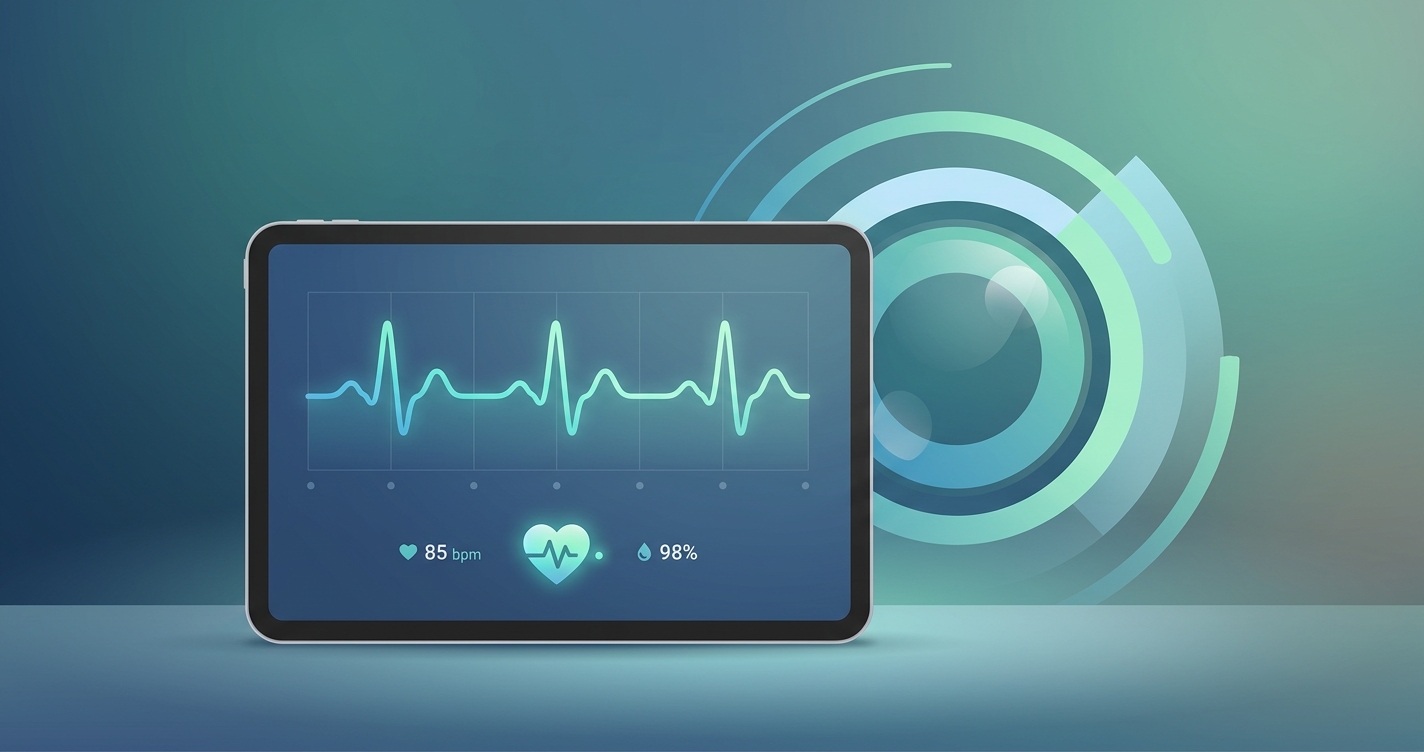
The explosion of wellness and health monitoring applications has placed powerful tools in the hands of consumers. Many tablets and smartphones now offer apps that claim to measure vital signs like heart rate using only the built-in camera. This raises a critical question for both users and hardware original equipment manufacturers (OEMs): is the heart rate my tablet app shows me safe to trust? The answer is complex and hinges on a crucial, often overlooked factor: the deep connection between the software algorithm and the specific hardware it runs on. For a tablet camera heart rate reliable reading, the model must be trained on the camera it uses. A generic app downloaded from an app store simply cannot provide that level of specificity and, therefore, reliability.
"A major challenge in the widespread application of rPPG is the generalization of trained models to unseen recording conditions (e.g., cameras, lightings) and subject demographics." - Nowara, E. M., et al. (2021)
Why generic apps fall short of reliability
Remote photoplethysmography (rPPG) is the technology that enables cameras to measure heart rate. It works by detecting subtle, imperceptible changes in the color of light reflected from the skin as blood pulses through subcutaneous vessels. While the principle is sound, its practical implementation is fraught with challenges. The data quality of the video stream is critical, and this is where device variability becomes a major obstacle.
An app developer who publishes a generic "heart rate reader" on an app store has no control over the hardware it will be installed on. They must create a one-size-fits-all model. This model is expected to work on a premium tablet with a high-end camera system as well as a budget device with a low-cost sensor. This inherent variability is why the answer to "is a tablet camera heart rate reliable?" is so often "no."
Key hardware factors include:
- CMOS Sensor Differences: Not all camera sensors are created equal. They have different quantum efficiencies, rolling shutter speeds, and noise profiles. A model trained on one sensor may fail to interpret the nuances of another.
- Image Signal Processor (ISP) Pipelines: Every tablet has a dedicated ISP that processes the raw data from the sensor. This pipeline includes proprietary, "black box" algorithms for auto-exposure, white balance, and noise reduction. These adjustments, designed to make photos look good to the human eye, can distort or destroy the subtle rPPG signal needed for vital signs measurement.
- Lens and Optical Assembly: The physical lens and its coatings can affect which wavelengths of light reach the sensor, further influencing the data a model receives.
A generic algorithm cannot account for these countless hardware permutations. It is trained on a broad, averaged dataset that represents no single device perfectly.
| Feature | Generic rPPG App | Sensor-Specific rPPG Model |
|---|---|---|
| Camera Support | "Universal" (best effort) | Calibrated for a specific sensor & lens |
| ISP Integration | Ignores ISP; treats it as a black box | Model is trained on post-ISP video |
| Low-Light Performance | Poor; high noise levels | Optimized for the sensor's noise profile |
| Motion Artifacts | High susceptibility | Can be co-trained with IMU data |
| Reliability | Low to moderate | High and predictable |
Industry applications for calibrated models
For hardware OEMs and device makers, relying on a generic app is not a viable strategy. The goal is to create integrated, reliable health sensing features that add significant value to a product. This requires a move away from the app-store model and toward custom-trained rPPG models calibrated for specific hardware.
Clinical and kiosk deployments
Fixed-camera systems, such as telehealth kiosks or hospital check-in tablets, are ideal environments for custom rPPG. Because the device, camera position, and lighting are controlled, a model can be trained for extremely high accuracy and reliability, providing valuable health screening data.
Automotive driver monitoring
In-cabin cameras are becoming standard for monitoring driver drowsiness and attention. By training a custom rPPG model on the specific near-infrared (NIR) cameras used in these systems, automotive OEMs can add robust, passive monitoring of driver stress and cardiac events.
Smart home and iot devices
From smart mirrors to baby monitors, ambient health sensing is a major growth area. A manufacturer of a smart mirror can commission a model trained specifically on its mirror camera and expected use case (e.g., a person standing 2-3 feet away in bathroom lighting) to deliver a seamless and reliable user experience.
Current research and evidence
The academic and R&D communities have long recognized the problem of generalizability. Research by De Haan and van Leest (2014) laid early groundwork on improving motion robustness, a key challenge. More recently, studies have focused on the "dataset bias" problem, where models perform well on the data they were trained on but fail when presented with data from a new camera. For instance, the PURE dataset, created by researchers at the University of Waterloo, was explicitly developed to help study the impact of different cameras and lighting on rPPG performance.
These studies confirm that for a tablet camera heart rate reliable measurement system to be built, the training and validation process must treat the camera not as an interchangeable component, but as an integral part of the sensing system. The most effective approach is to collect a dedicated dataset using the final production hardware and use it to train a model from scratch or through a process called transfer learning.
The future of camera-based vitals: sensor-specific AI
The future of contactless vital signs monitoring does not lie in generic apps. It lies in embedded, highly optimized AI models that are purpose-built for the devices they inhabit. For OEMs, this represents a shift in thinking: the camera is not just for pictures anymore. It is a sophisticated biosensor, and like any sensor, it requires careful calibration.
This hardware-specific approach is the only path to creating products that can be trusted for more than just novelty use. It transforms a feature from a "fun gimmick" into a reliable health and wellness tool, creating a significant competitive advantage and unlocking new product categories.
Frequently asked questions
Why does the same app give different heart rate readings on different tablets? The app relies on the tablet's specific camera sensor and image signal processor (ISP). These components vary widely between models, leading to different raw data quality and, therefore, different results from a generic algorithm.
What is an Image Signal Processor (ISP) and why does it matter? The ISP is a chip inside the tablet that converts the raw data from the camera sensor into a usable image. Its proprietary tuning for color, noise, and brightness dramatically affects the subtle skin-pixel data needed for rPPG, making ISP characteristics a key factor in model performance.
Can any tablet camera be used for reliable heart rate monitoring? Not with a generic, one-size-fits-all app. For a tablet camera heart rate to be reliable, the underlying rPPG model must be specifically trained and calibrated for that exact camera sensor, lens, and ISP combination.
How is a custom-trained model different from a standard app? A standard app uses a generic model designed to work on an average device, sacrificing accuracy. A custom-trained model is built using data exclusively from the target camera hardware, allowing it to learn and account for its specific optical and processing characteristics, resulting in significantly higher reliability.
As a hardware manufacturer, ensuring your product delivers consistent and accurate results is critical. Circadify specializes in developing custom rPPG models trained and calibrated for your specific camera hardware. If you are developing a tablet, kiosk, or other fixed-camera device and want to integrate reliable, camera-based vital signs monitoring, we can help you build a solution that works. Learn more about our process by visiting our page on custom builds.