
IR Thermal Vitals Model: How Cameras Read Fever Hands-Free
How an IR thermal vitals model reads temperature, respiration, and heart rate without touch, where infrared sensing breaks down, and what OEMs should plan for.
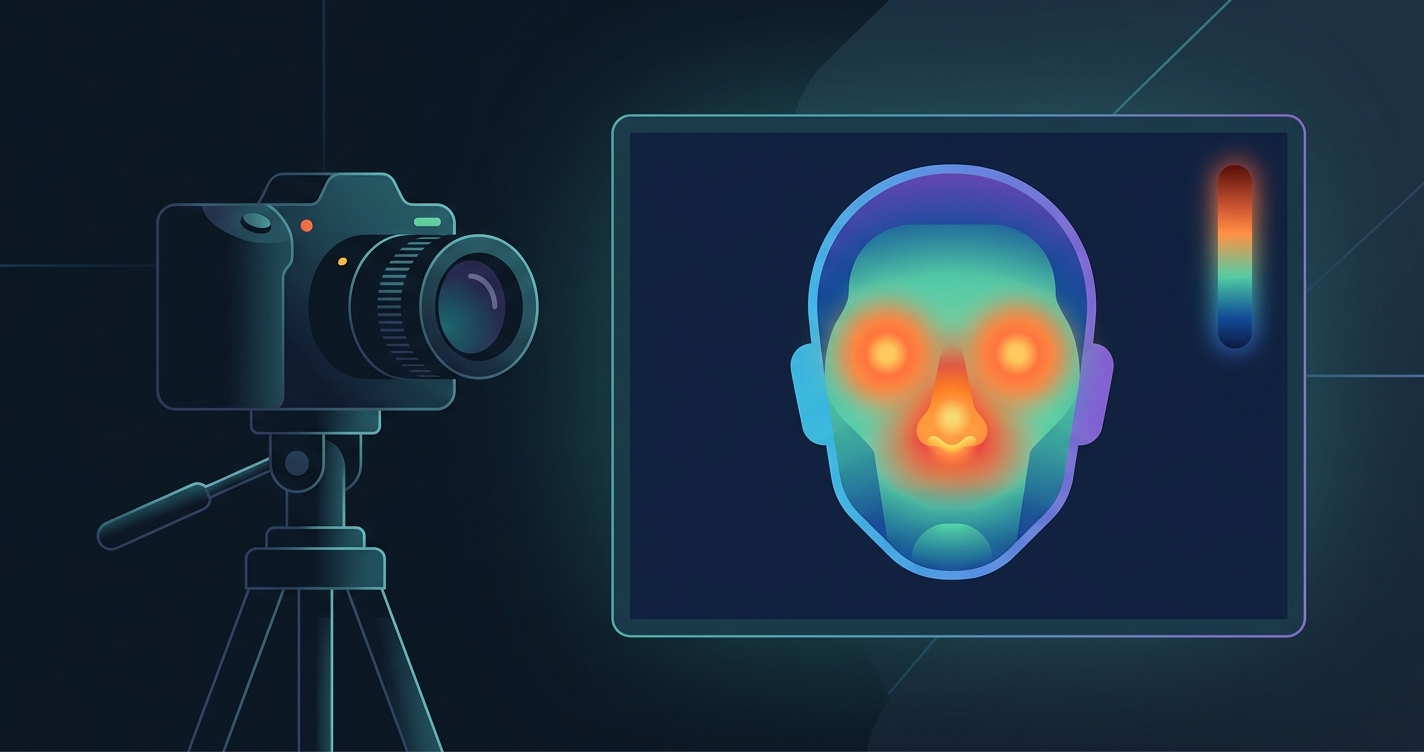
Hardware teams evaluating contactless health features almost always reach for a thermal sensor first, because the promise is intuitive: a camera that reads body heat should be able to flag a fever from across a room. An IR thermal vitals model turns that raw heat map into clinically meaningful numbers, and it does far more than a single temperature spot read. A well-trained model can estimate skin temperature, respiration rate, and in narrow conditions a pulse signal, all without a person touching anything. The catch is that thermal imaging is governed by physics that do not bend to marketing copy, and the difference between a demo and a shippable product lives almost entirely in how the model is trained for a specific sensor and use case.
"Even at the inner canthus, the most reliable facial site, measured skin temperature typically runs several degrees below core temperature, ranging from roughly 33.5 to 36.9 degrees Celsius.", drawn from clinical fever-screening guidance summarized in MDPI's 2022 review of infrared thermography best practices.
What an IR thermal vitals model actually measures
A thermal camera does not see a fever. It sees a two-dimensional grid of radiometric values, where each pixel represents emitted long-wave infrared radiation that gets converted to an apparent temperature. An IR thermal vitals model is the software layer that locates anatomy, picks the right measurement region, corrects for environmental bias, and translates surface readings into estimated physiology. Three signals come out of that pipeline, each with very different reliability.
- Temperature: the strongest signal. The model isolates the inner canthus (the tear duct corner of the eye), the facial region least insulated by tissue and most stable against airflow, then maps surface temperature toward an estimated core value.
- Respiration: a robust secondary signal. Air exhaled through the nostrils and mouth is warmer than inhaled air, so the model tracks a periodic temperature oscillation around the nose to derive breaths per minute.
- Heart rate: the weakest signal in pure thermal. Pulsatile blood flow causes faint temperature modulation over superficial vessels, but the amplitude is tiny and easily buried in noise, which is why production heart-rate features usually fuse thermal with an RGB or near-infrared rPPG channel.
For OEMs, the key framing is that thermal health sensing is not one feature but three features with three different difficulty curves. Treating them as a bundle that ships together is the most common planning mistake.
Why the sensor choice drives everything
Thermal cameras are not interchangeable. A radiometric sensor outputs calibrated absolute temperatures per pixel, while a non-radiometric module outputs relative grayscale that looks identical on screen but cannot anchor a fever threshold without an external reference. Resolution matters too: a 320x240 microbolometer resolves the inner canthus at conversational distance, but a low-cost 80x60 array may render that region as a handful of pixels at the same range. The Noise Equivalent Temperature Difference, or NETD, sets the floor on how subtle a signal the model can recover, which directly governs whether respiration and pulse are even extractable.
Contactless temperature reading vs other vitals methods
The table below compares thermal sensing against the two other dominant contactless approaches so hardware planners can place an IR thermal vitals model in context rather than treating it as a universal solution.
| Method | Best Signal | Temperature Capable | Heart Rate Capability | Works In Darkness | Main Weakness |
|---|---|---|---|---|---|
| IR thermal vitals model | Temperature, respiration | Yes, with calibration | Weak, fusion recommended | Yes | Drift from ambient and airflow |
| RGB camera rPPG | Heart rate, HRV | No | Strong in good light | No | Fails in low light, skin-tone bias |
| Near-infrared rPPG | Heart rate, respiration | No | Moderate to strong | Yes | Needs active illumination |
A few practical takeaways follow from this comparison:
- Thermal is the only single-sensor route to a true contactless temperature reading, which is why fever screening keeps pulling teams toward it.
- For heart rate alone, an RGB or near-infrared rPPG model usually outperforms a thermal-only approach by a wide margin.
- The strongest in-cabin and clinical designs fuse a thermal channel for temperature and respiration with an rPPG channel for pulse, rather than forcing one sensor to do everything.
Industry applications of thermal health sensing
Automotive in-cabin monitoring
Driver and occupant monitoring systems already run infrared cameras for gaze and drowsiness tracking, which makes thermal an attractive add-on. A thermal channel can track respiration during fatigue events and flag occupant thermal comfort, but cabin airflow from vents, sun-loaded surfaces, and rapid ambient swings create exactly the conditions that degrade fever-grade accuracy. Models here must be trained against the cabin's specific thermal turbulence rather than lab calm.
Access control and public screening
Entryway fever screening drove the largest deployment wave for thermal cameras, and it exposed the field's core limitation: surface temperature is not core temperature. Guidance consistently calls for one person at a time, a controlled indoor staging area, and an external blackbody reference to anchor calibration. An IR thermal vitals model built for this setting leans heavily on environmental correction rather than raw pixel values.
Telehealth and clinical kiosks
Fixed-distance kiosks offer the most forgiving geometry for thermal sensing because subject distance, lighting, and background are controlled. This is where contactless temperature plus respiration can approach useful clinical screening quality, provided the model is calibrated to the exact sensor and mounting geometry of the device.
Current research and evidence
The peer-reviewed record is clear that thermal vitals sensing works within bounds and that machine learning is what pushes accuracy from indicative to useful. A 2023 study by researchers publishing on OpenReview and arXiv demonstrated that pairing infrared thermography with a convolutional neural network improved fever detection, reporting a root mean square error of about 0.22 degrees Celsius against reference temperature, a meaningful gain over fixed-offset spot reads.
Calibration discipline matters just as much as the model. A 2023 clinical evaluation of fever-screening thermography found that combining infrared imaging with an external temperature reference kept absolute measurement error below roughly 0.12 degrees Celsius, while uncontrolled setups drifted well beyond clinically acceptable limits. The recurring theme across this work is that the inner canthus is the preferred facial site, and that makeup, perspiration, eyewear, and masks all corrupt the reading.
On the dynamic vitals side, a 2022 review in Frontiers in Physiology and a 2023 review in MDPI's Sensors both concluded that thermal imaging reliably recovers respiration rate from nasal airflow patterns, while thermal-only heart rate remains sensitive to motion and low signal amplitude. Both reviews point to signal processing and noise reduction, increasingly deep-learning based, as the deciding factor in whether a thermal pulse signal is recoverable at all. The consistent message for product teams is that a generic thermal model trained on someone else's camera and someone else's room will not transfer cleanly to a new device.
- Environmental factors (ambient temperature, humidity, airflow, distance) are the dominant error source, not the sensor alone.
- Respiration extraction is mature; heart rate from thermal alone is still fragile.
- Machine-learning correction outperforms fixed-offset calibration for fever-grade temperature.
The future of IR thermal vitals sensing
Three trends are shaping where this technology goes next. First, sensor fusion is becoming the default architecture rather than an upgrade, with thermal handling temperature and respiration while a co-located rPPG channel handles pulse and heart-rate variability. Second, falling microbolometer prices are putting radiometric thermal into consumer-class devices, which expands the addressable market but also widens the range of uncalibrated, low-resolution sensors that models must be trained against. Third, on-device inference is replacing cloud processing, meaning the IR thermal vitals model has to run inside tight power and memory budgets on an embedded processor without sacrificing the environmental correction that makes it trustworthy.
The practical implication for OEMs is that the moat is no longer the camera, which competitors can also buy, but the model trained specifically for that camera, mounting geometry, and operating environment. A thermal health sensing model that performs in a clinic lobby will not automatically perform in a moving vehicle or a wall-mounted smart panel, and that gap is what separates a marketable feature from a returned product.
Frequently asked questions
Can a thermal camera measure heart rate without any other sensor?
It can in controlled conditions, but the thermal pulse signal is weak and easily lost to motion and ambient noise. For dependable heart rate, most production designs fuse a thermal channel with an RGB or near-infrared rPPG channel rather than relying on thermal alone.
Why does thermal camera fever detection read lower than a thermometer?
Thermal cameras measure skin surface temperature, which sits several degrees below core temperature even at the inner canthus. An accurate IR thermal vitals model applies calibration and, ideally, an external reference to estimate core temperature rather than reporting the raw surface value.
What ruins a contactless temperature reading?
Airflow, ambient temperature swings, subject distance, eyewear, makeup, perspiration, and recent exertion all shift the surface reading. Controlled staging and per-device calibration are required to keep error within a useful range.
Does a thermal vitals model transfer between different cameras?
Not reliably. Resolution, NETD, radiometric calibration, and optics differ across modules, so a model trained on one sensor typically needs retraining or substantial recalibration to perform on another.
At Circadify we work with hardware OEMs building thermal and infrared devices to train an IR thermal vitals model around the exact sensor, optics, and operating environment in your product rather than forcing a generic engine to fit. If you are scoping a thermal health sensing feature and want a realistic read on what your camera can and cannot deliver, start a custom build inquiry at circadify.com/custom-builds.