
7 Things Automotive Suppliers Need for In-Cabin Vitals
What Tier-1 suppliers must get right on the in-cabin vitals monitoring camera: NIR lighting, sensor format, sync, framerate, skin-tone coverage, and data pipeline.
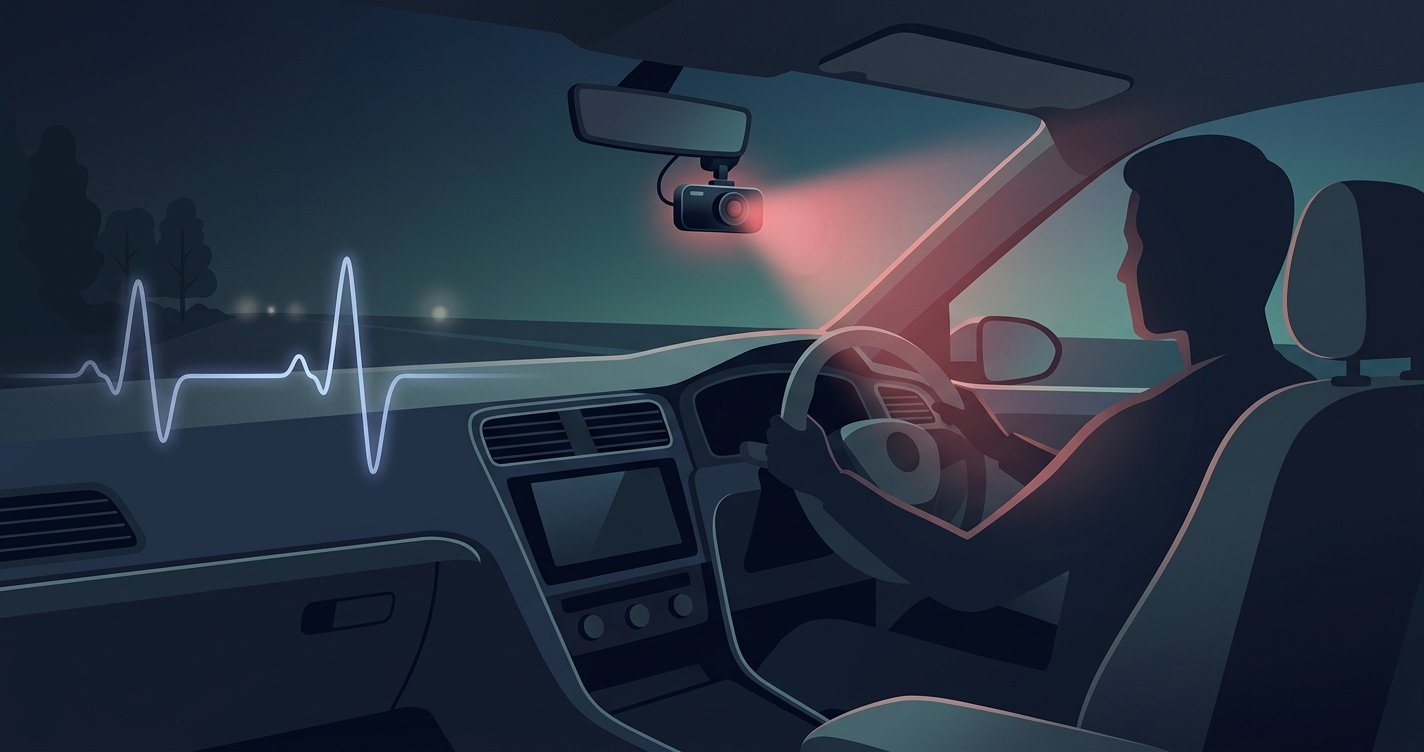
Driver monitoring has shifted from a differentiator to a procurement line item, and the camera bolted to the steering column is now expected to do far more than count blinks. Regulators want impairment and drowsiness detection, and OEMs want a path to heart rate and breathing rate from the same hardware. For automotive Tier-1 suppliers, the practical question is no longer whether an in-cabin vitals monitoring camera can read a pulse, but which camera, lighting, and data choices make that reading survive a real cabin in direct sun, at night, across every occupant. Getting those choices wrong early forces an expensive redesign late, usually during a customer pilot.
Euro NCAP's 2026 protocol allocates up to 25 points to driver monitoring systems and requires detection of distraction, drowsiness, and impairment within the first 10 minutes of a trip at speeds of 50 km/h or higher, making direct camera-based sensing effectively mandatory for a five-star rating.
- Smart Eye, Driver Monitoring 2.0 briefing, 2025
Why the in-cabin vitals monitoring camera is a systems problem
Camera-based vitals in a vehicle rely on remote photoplethysmography (rPPG), which extracts a blood-volume pulse from tiny periodic changes in skin reflectance across video frames. The signal is real but minute, often a fraction of a percent of pixel intensity. Inside a cabin, that fragile signal competes with bright sunlight, deep shadow, vibration, head motion, and occupants wearing sunglasses or masks. The in-cabin vitals monitoring camera is therefore not a component you specify in isolation. It is the front end of a pipeline where the illuminator, the sensor, the synchronization, and the model all have to agree on what good data looks like.
Suppliers who treat driver health sensing as a software feature added after sensor selection usually discover that the chosen camera, optimized for gaze tracking or cost, throws away the exact information rPPG needs. Below are the seven requirements that separate a demo from a program that survives validation.
| Requirement | What to specify | Why it matters for cabin camera heart rate |
|---|---|---|
| NIR illumination | 940nm active light, eye-safe, uniform across the seat | Invisible to occupants, resists sunlight interference, works in darkness |
| Sensor format | Global shutter, RGB-IR or dedicated NIR, 10-bit+ depth | Avoids motion skew, preserves the small pulsatile signal |
| Framerate and stability | 30-60 fps, locked exposure and gain | Pulse and respiration need consistent temporal sampling |
| Light-sensor sync | Illuminator strobing locked to frame integration | Removes ambient flicker and keeps signal-to-noise usable |
| Dynamic range | HDR or local tone handling for sun vs shadow | Faces survive backlight without clipping skin pixels |
| Skin-tone coverage | Training and validation across Fitzpatrick I-VI | Prevents accuracy collapse on darker skin |
| Data and compute pipeline | Raw or lightly compressed feed, on-edge inference | Compression and cloud latency destroy or delay the signal |
1. NIR Lighting at 940nm, Not Visible Light
The cabin has no controllable lighting, so the system has to bring its own. Near-infrared illumination at 940nm is the consensus choice because it is largely invisible to the human eye, can be driven at higher intensity without eye-safety concerns, and sits in a band where direct sunlight has less interfering energy than at shorter wavelengths. Continental and trinamiX demonstrated a biometric sensing display at CES 2025 built around a near-infrared camera and an eye-safe dot projector specifically to track parameters including heart rate, a clear signal that NIR is the production direction.
2. global-shutter sensor with enough bit depth
A rolling shutter smears moving subjects, and a driver is always moving. A global-shutter sensor captures the whole frame at one instant, which keeps the per-frame skin reflectance measurement honest. Bit depth matters just as much. The pulsatile component rPPG depends on can be smaller than the step between adjacent 8-bit levels, so 10-bit or deeper output gives the model room to see it. RGB-IR sensor architectures are increasingly favored because they let one camera serve gaze, occupant classification, and vitals from a shared feed.
3. stable framerate and locked exposure
Heart rate sits roughly between 0.7 and 3 Hz and respiration far lower, so the camera has to sample faithfully over time. A camera that drops frames, hunts on auto-exposure, or floats its gain to make a pretty picture introduces artifacts the model cannot separate from physiology. A locked 30 to 60 fps feed with fixed exposure and gain, even if it looks flat to a human, is what driver health sensing actually needs.
4. illuminator-to-sensor synchronization
Ambient light in a cabin flickers from passing streetlights, oncoming headlamps, and dappled sun through trees. Strobing the NIR illuminator in lockstep with sensor integration suppresses that ambient contribution and stabilizes signal-to-noise. Without this sync, the same hardware that reads cleanly on a test bench can fail on a tree-lined road at dusk.
Industry Applications
Regulatory driver state monitoring
The most immediate driver is compliance. With Euro NCAP weighting driver monitoring heavily from 2026 and the EU General Safety Regulation pushing the same direction, suppliers are adding vital-sign estimation on top of the gaze and head-pose pipelines they already ship. Smart Eye demonstrated heart rate and breathing rate estimation from existing cabin cameras at an InCabin event, and the appeal is cost: reusing the regulatory camera for vitals avoids a second sensor.
Occupant well-being and comfort
OMNIVISION and Philips jointly showed an in-cabin well-being prototype monitoring pulse and breathing rate at AutoSens Europe in 2024, aimed at comfort and health features rather than pure safety. Magna reports vital-sign monitoring within its interior sensing systems across multiple OEM programs in North America, Europe, and Asia. These applications widen the requirement set, since rear-seat and passenger sensing add distance, angle, and occlusion challenges beyond the driver position.
Fleet and commercial vehicles
Commercial fleets care about fatigue and medical-event detection during long shifts. Here the cabin geometry is more predictable, but duty cycles are long and lighting swings are extreme, raising the bar on dynamic range and the data pipeline.
Current research and evidence
Peer-reviewed and applied research increasingly confirms that camera vitals in vehicles are feasible but hardware-bound. Work presented through AutoSens on vehicle occupant heart rate and respiration estimation using an RGB-NIR camera applied deep learning with optical flow to recover both pulse from the face and respiration from chest movement, reinforcing that fusing signals beats relying on facial reflectance alone in a moving cabin. IDTechEx, in its In-Cabin Sensing 2024-2034 market analysis, frames vital-sign monitoring as a growing pillar of cabin sensing demand rather than a niche.
A consistent theme across this literature is that performance depends on the specific camera and illumination, not on a portable algorithm. Two cabins with different sensors, lens stacks, and NIR placement produce different raw signals, so a model tuned for one will underperform on the other. The other recurring finding concerns skin tone. Because rPPG reads reflected light from skin, melanin changes the available signal, and systems validated only on lighter skin degrade on Fitzpatrick V and VI. Building and validating across the full range is a requirement, not a refinement.
- Fuse facial pulse with chest-motion respiration to stay robust under head movement.
- Validate on the exact production sensor and illuminator, not a development kit.
- Treat skin-tone coverage as a pass or fail validation gate.
- Plan for on-edge inference so cabin latency and connectivity never gate the result.
The future of in-cabin vitals monitoring camera systems
The direction of travel is one shared, multi-purpose NIR camera per cabin that delivers gaze, occupant classification, and vitals from a single feed, with inference running on the domain controller rather than in the cloud. Multimodal fusion will mature, blending camera signals with radar and seat-based sensors so a missing modality degrades gracefully instead of failing outright. As regulation expands from driver to occupants, suppliers will need pipelines that handle multiple seats, angles, and body sizes. The constant across all of it is that the sensing quality is set at the hardware and model layer. A vitals model trained generically and dropped onto a chosen camera will keep losing the signal that the cabin already makes hard to see.
Frequently asked questions
Can one camera handle both driver monitoring and vitals?
Yes, and that is the cost-efficient path most suppliers pursue. An RGB-IR or NIR camera already specified for gaze and distraction can also feed rPPG, provided it offers a global shutter, sufficient bit depth, stable framerate, and synchronized NIR illumination. The constraint is usually that cameras chosen purely for gaze discard the temporal and radiometric quality vitals need.
Why is 940nm preferred over visible or 850nm light?
940nm is nearly invisible to occupants, so it does not distract at night, it can be driven at safe intensities, and sunlight carries less interfering energy in that band than at shorter wavelengths. 850nm produces a faint visible glow and competes more with ambient light, which is why 940nm has become the default for in-cabin sensing.
Does skin tone really affect camera-based heart rate?
It does. rPPG measures light reflected from skin, and higher melanin reduces the available pulsatile signal, so systems trained and validated only on lighter skin lose accuracy on darker skin. Coverage across Fitzpatrick I through VI in both training and validation is necessary to ship a credible system.
Can the vitals run without a cloud connection?
They should. Cabin connectivity is intermittent and safety features cannot wait on a round trip. Running inference on the in-vehicle compute keeps latency low and the feature available regardless of network, which also helps with occupant privacy.
Circadify is addressing exactly this gap for automotive Tier-1 suppliers: rPPG models trained against your specific cabin camera, NIR illuminator, and seating geometry rather than a generic engine that fights your hardware. If driver health sensing is on your roadmap and you want a model matched to the sensor you have already selected, start a custom build inquiry.