How to Add Heart Rate Sensing to Your IoT Device
A step-by-step overview of integrating contactless heart rate into connected products using a custom IoT health sensing model.
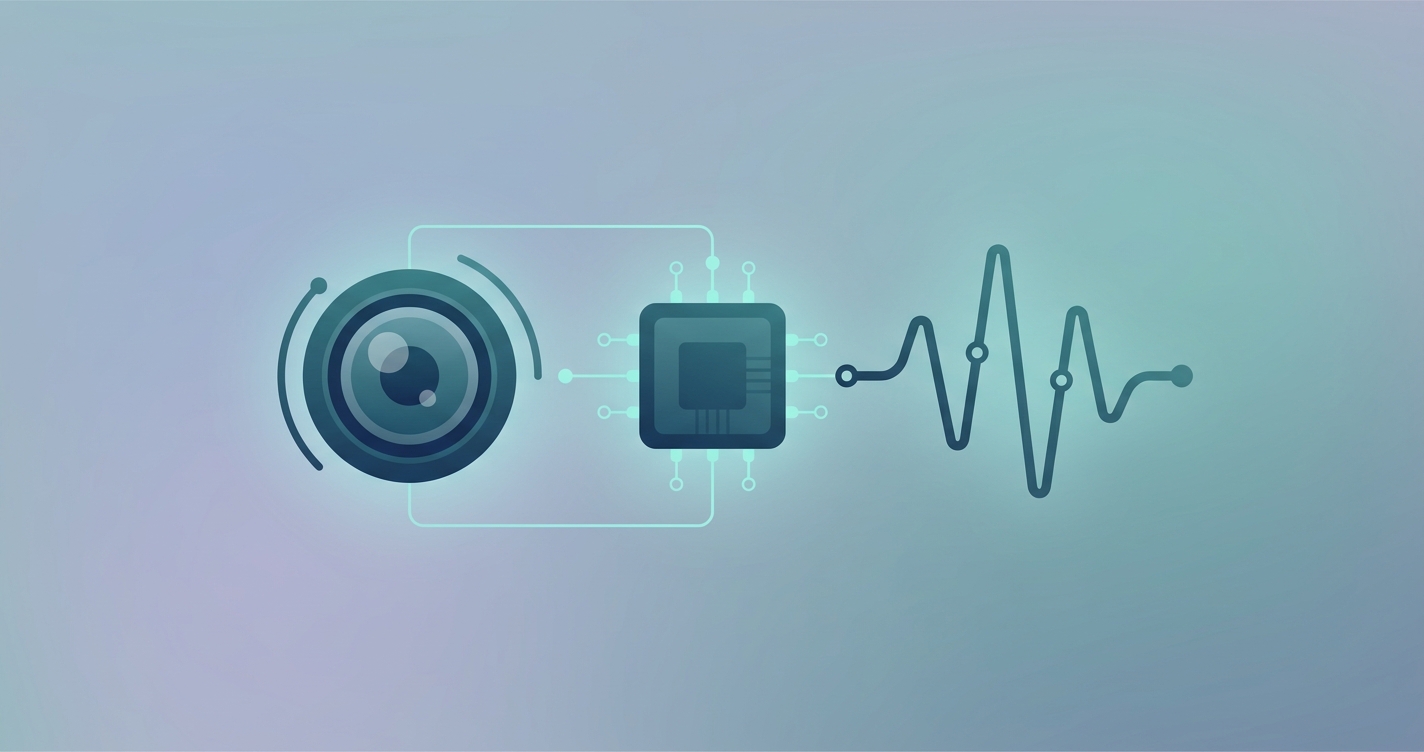
Hardware designers are increasingly expected to add passive health sensing to objects that never tracked biology before. A camera mounted in a vehicle cabin, a lens embedded in smart glasses, or an optical sensor on a baby monitor is no longer just for capturing images. The expectation is that these devices will monitor human physiology continuously and invisibly. However, turning a standard CMOS or infrared sensor into a reliable pulse reader is a complex engineering problem. For teams attempting to build an IoT health sensing model, the challenge lies in the physics of light, skin, and sensor noise. Trying to add vitals to a device using a generic, one-size-fits-all software package usually results in high error rates, especially under varied lighting conditions or across different skin tones.
"The IoT Vital Signs Monitoring Devices Market is projected to grow from US$ 21.14 billion in 2024 to US$ 90.70 billion by 2033, with a compound annual growth rate of 17.56 percent, driven by the increasing demand for remote patient monitoring." (Business Market Insights, 2024)
The architecture of an iot health sensing model
Building a reliable system requires a foundational understanding of remote photoplethysmography (rPPG). This technology measures the micro-vascular changes in skin color that occur with each heartbeat. While the concept is straightforward in a brightly lit laboratory, real-world IoT vital signs integration is far more hostile. Devices must process video streams subject to motion artifacts, low ambient light, and severe hardware compression.
An effective IoT health sensing model operates at the intersection of optics and edge computing. It cannot rely entirely on cloud processing due to latency, bandwidth costs, and privacy regulations regarding video data. Instead, the computational load must occur directly on the device. This requires compiling the rPPG algorithm to run efficiently on low-power neural processing units or specific image signal processors. A generic software development kit typically fails here because it assumes a perfect, uncompressed video feed and massive computational headroom.
Hardware teams must transition from generic software to custom-trained models. A custom model is trained directly on the specific video outputs of the device's exact camera sensor, lens, and image signal processor combination. This ensures the algorithm understands the specific noise profile and color space of the production hardware.
| Feature | Custom-Trained IoT Model | Generic Off-the-Shelf Software |
|---|---|---|
| Sensor Optimization | Trained on exact camera and lens profile | Assumes generic web camera input |
| Edge Compute Load | Optimized for specific NPU or DSP | Often requires heavy CPU usage |
| Low-Light Performance | High accuracy (trained on device noise) | High error rates in dim lighting |
| Bandwidth Requirements | Processes frames entirely on-device | Often requires cloud API transmission |
| Skin Tone Equity | Tuned via diverse custom datasets | Highly variable performance |
Core steps for iot vital signs integration
Engineers planning to introduce contactless heart rate IoT capabilities must follow a structured integration pipeline. Treating the algorithm as a simple software library injected at the end of the development cycle guarantees failure.
- Define the optical baseline: Before writing any code, the hardware team must lock in the camera specifications. Changing the lens aperture, the sensor size, or the infrared filter mid-project will invalidate the training data for the algorithm. Every micro-change in the optical path alters how the sensor perceives blood volume pulses.
- Capture device-specific data: Data collection must occur using the exact production hardware. Engineers need to record subjects across diverse skin tones, varying ambient lighting conditions, and typical user motion patterns. This creates the ground truth required for the neural network.
- Train the edge network: Machine learning engineers use this device-specific dataset to train a lightweight neural network. The goal is to maximize the signal-to-noise ratio for that specific camera profile, teaching the algorithm to ignore the unique artifacts generated by that exact lens and sensor pairing.
- Optimize for local compute: The resulting model must be quantized and pruned to fit the memory constraints of the IoT device. If the device uses a specific system-on-chip, the model should be compiled to use hardware acceleration, ensuring the health monitoring feature does not drain the battery or overheat the system.
Industry Applications
The deployment of camera-based vitals is rapidly expanding across multiple hardware sectors, transforming simple recording devices into active health monitors.
Automotive driver monitoring
In-cabin sensing is transitioning from simple drowsiness detection to complex physiological monitoring. Automotive Tier-1 suppliers are integrating rPPG into infrared cameras mounted on the steering column. These systems monitor the driver for sudden changes in heart rate variability, which can indicate acute medical events or severe cognitive load. Because vehicle cabins experience dramatic lighting changes, these models rely heavily on custom infrared data training to function at night.
Connected smart glasses
Wearable augmented reality devices and smart glasses are incorporating health features without requiring skin contact. Tiny cameras embedded in the frames can monitor the micro-vascular pulses on the wearer's face. The primary engineering constraint here is battery life and thermal management. The sensing models must be exceptionally lightweight to prevent the processor from overheating the frames while maintaining continuous tracking.
Clinical edge devices and kiosks
Telehealth companies are deploying diagnostic kiosks equipped with fixed cameras. These machines require high clinical accuracy to triage patients before they see a doctor. By utilizing controlled lighting within the kiosk and custom-trained rPPG algorithms, these devices can capture heart rate and respiratory rate with high fidelity, reducing the need for traditional finger sensors and minimizing cross-contamination risks.
Current research and evidence
The academic consensus on remote photoplethysmography has shifted significantly over the past two years. Early research focused heavily on visible-light webcams in highly controlled, perfectly lit laboratory settings. Recent literature highlights the absolute necessity of hardware-specific training for dynamic environments.
In a 2023 study published in MDPI, researchers demonstrated that generic machine learning models suffer a severe drop in accuracy when subjected to dynamic lighting and sudden subject motion. Their findings indicate that deep learning algorithms must be explicitly trained on multimodal datasets that reflect the specific optical noise of the capture device. Without this customized training, the models fail to isolate the blood volume pulse from environmental interference.
Furthermore, a 2024 review in Frontiers concerning deep learning and contactless physiological measurement confirmed that edge computing is mandatory for real-time applications. The researchers noted that sending raw video data to the cloud introduces unacceptable latency and significant privacy risks. By compiling custom rPPG networks directly onto IoT edge processors, developers can maintain signal integrity while strictly keeping video data local. These studies prove that an IoT health sensing model must be fundamentally integrated with the physical hardware it runs on.
The future of contactless heart rate in iot
The next generation of connected hardware will not treat vital signs monitoring as a novel feature, but as a baseline expectation. As neural processing units become standard in even the cheapest microcontrollers, the computational barrier to entry for robust rPPG will disappear.
Future devices will likely employ multi-modal sensing to achieve unprecedented accuracy. A smart speaker might combine radar-based micro-movement tracking with an infrared camera to cross-validate a subject's respiratory rate in complete darkness. We will also see a massive reduction in the power required to run these models. Techniques like event-based vision, where the camera only records changes in the scene rather than processing full dense frames, will allow battery-powered IoT devices to monitor heart rate continuously for months without a recharge.
Ultimately, the hardware teams that succeed will be those that abandon generic software APIs. The future belongs to tightly integrated systems where the lens, the sensor, the processor, and the machine learning model are designed together as a single, cohesive physiological measurement tool.
Frequently asked questions
Can any generic webcam measure heart rate accurately?
While generic webcams can measure heart rate in perfect laboratory conditions, they fail in real-world environments. Reliable measurement requires a custom algorithm trained specifically on the noise profile, color space, and optical characteristics of the specific production camera.
Does contactless vital sensing require a connection to the cloud?
No. Modern IoT devices run these models entirely on the edge. The algorithm processes the video frames locally in real time, extracting the vital signs data and immediately discarding the video. This protects user privacy, reduces latency, and minimizes bandwidth costs.
Why do generic rPPG models fail on different skin tones?
Generic models are often trained on limited, public datasets that lack optical diversity. A custom-built model ensures the algorithm is trained on diverse data captured by your specific hardware, teaching the system how to accurately extract the blood volume pulse across all melanin levels and lighting conditions.
What is the impact of video compression on an IoT health sensing model?
Video compression algorithms are designed to discard visual data that the human eye cannot see, which unfortunately includes the micro-color variations required for accurate heart rate extraction. By processing the raw, uncompressed frames directly on the edge device before compression occurs, a custom model preserves the physiological signal and delivers high accuracy.
Adding physiological monitoring to your hardware roadmap is a complex engineering challenge, but you do not have to solve the optical physics alone. If you are preparing to launch a connected product and need an algorithm that actually works on your specific camera, the tryvitalsapp.com Research Team is ready to help. We specialize in building custom-trained rPPG models optimized entirely for your unique hardware, sensor, and use case. Stop struggling with generic software that fails in low light and high motion. Book an integration call today and explore a custom build at circadify.com/custom-builds.