How can a doctor's webcam check my breathing during a video visit?
Discover how telehealth platforms use standard webcams to measure vital signs like breathing and heart rate during a video visit through advanced signal processing.
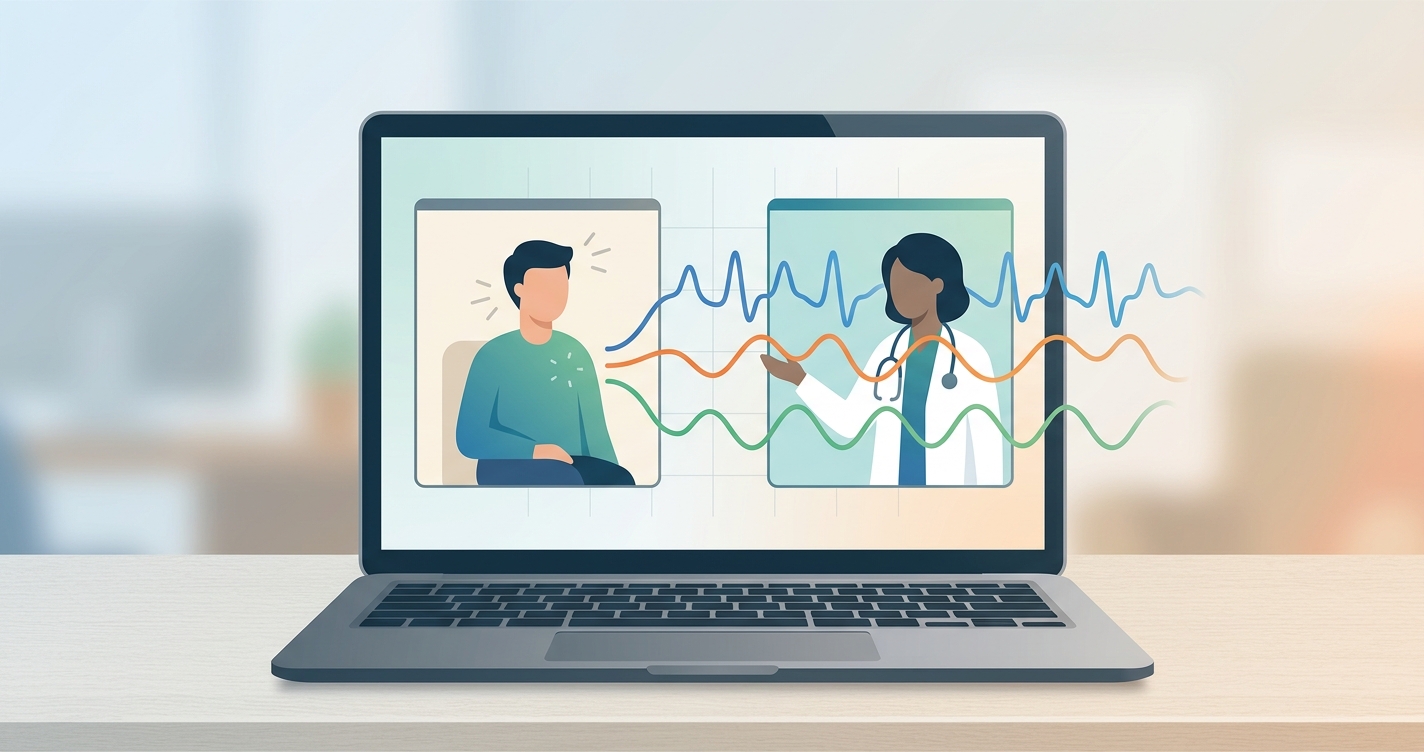
The experience is becoming more common for patients using virtual care platforms: you are in a video appointment, and the doctor mentions they are assessing your heart rate or breathing, not with a device, but simply by observing you through your computer's webcam. This capability is not a guess; it is the result of significant engineering advancements in computer vision and signal processing. The ability to measure telehealth webcam vital signs is transforming virtual consultations from simple conversations into data-rich clinical encounters, all through the camera you already own.
"The COVID-19 pandemic greatly accelerated the adoption of remote health monitoring technologies. We saw a surge in research demonstrating that consumer-grade cameras could, with the right software, provide measurements of heart rate, respiratory rate, and even blood pressure with surprising accuracy, often within clinically acceptable margins of error." - Dr. John Allen, Institute of Cellular Medicine, Newcastle University (paraphrased from studies)
How telehealth webcam vital signs are measured
Extracting physiological signals from a video stream sounds like science fiction, but it is based on two well-established scientific principles. Software algorithms analyze the video feed from your webcam in real-time, looking for imperceptible changes in your appearance that correlate directly with your body's functions. These methods are broadly categorized into motion analysis for breathing and remote photoplethysmography (rPPG) for heart rate.
Breathing rate via motion analysis
Your breathing rate, or respiratory rate, is determined by tracking the subtle, repetitive motions associated with inhalation and exhalation. An advanced algorithm identifies key landmarks on your body, typically the chest and shoulders, and measures their displacement frame by frame.
- The system creates a time-series graph of this motion.
- The algorithm then analyzes this graph to find the frequency of the pattern, which corresponds to your breaths per minute.
This method is a form of motion magnification, making tiny movements visible to the software. Seminal work by researchers at MIT laid the groundwork for these techniques, which can also be adapted to track the subtle head movements that occur with breathing when the chest is not visible.
Heart rate via remote photoplethysmography (rppg)
Measuring heart rate works differently. It relies on a technology called remote photoplethysmography (rPPG), which detects changes in skin color caused by the pulsing of blood. Here is how it works:
- Light Absorption: Your webcam's sensor, especially the green channel, is sensitive to light. Hemoglobin in your blood absorbs light.
- Blood Volume Pulse: With each heartbeat, blood is pumped through the vessels in your face. This causes a tiny, cyclical increase in the volume of blood.
- Color Change Detection: As blood volume increases, more light is absorbed, and slightly less light is reflected into the camera. These changes are invisible to the naked eye but detectable by a sensitive camera sensor.
- Signal Processing: Sophisticated algorithms isolate this periodic signal from other "noise" in the video, such as changes in lighting or small movements. The frequency of this signal is your heart rate.
This principle was first explored in detail by researchers like Wim Verkruysse and his colleagues in a foundational 2008 paper, demonstrating that a simple digital camera could extract a person's pulse.
Contact vs. camera-based vitals: a comparison
| Feature | Contact-Based Monitoring | Camera-Based Monitoring (Telehealth) |
|---|---|---|
| Heart Rate | ECG sensor, chest strap, or contact fingertip clip (pulse oximeter). | Remote Photoplethysmography (rPPG) analyzes facial video. |
| Respiratory Rate | Chest strap with a strain gauge or impedance pneumography. | Motion analysis of chest, shoulder, or head movements via webcam. |
| Hardware Required | Dedicated medical or fitness device. | Existing consumer-grade webcam on a laptop, tablet, or phone. |
| Convenience | Requires physical application and pairing of a device. Can be cumbersome. | Completely frictionless and non-intrusive for the user. |
| Accuracy Factors | Dependent on sensor placement, skin contact, and device calibration. | Dependent on lighting conditions, camera quality, user motion, and skin tone. |
Industry Applications
The integration of telehealth webcam vital signs is creating new possibilities across the healthcare landscape.
Enhancing virtual consultations
For clinicians, having objective data during a telehealth visit is invaluable. It allows them to move beyond subjective patient descriptions to make more informed assessments of conditions like respiratory infections, anxiety, or medication side effects.
Remote patient monitoring (rpm)
Chronic disease management is a primary use case. Patients with conditions like heart failure or COPD can have their baseline vitals tracked daily without needing to use a separate device. This allows care teams to intervene earlier when subtle changes are detected.
Digital wellness and triage
Many wellness apps and preliminary care platforms are incorporating camera-based measurements to provide users with health insights or to better triage their needs before they even speak to a clinician.
Current research and evidence
The scientific community has been actively validating and improving these technologies. A 2021 study published in the journal Sensors by a team led by Christian S. S. F. Tjoa confirmed that rPPG can achieve high accuracy for heart rate measurement under various conditions. Similarly, extensive research from institutions like the University of Washington has focused on making these systems robust to real-world challenges, such as a person moving or poor lighting. A key area of ongoing research is domain adaptation, tuning algorithms to perform accurately across the wide variety of consumer webcams, lighting environments, and user populations encountered in real-world telehealth.
The future of webcam vitals
The future of telehealth webcam vital signs lies in multi-modal analysis and greater specialization. Future systems will not just measure heart and breathing rates but may also assess blood pressure, oxygen saturation, and stress levels by fusing camera data with other inputs. However, the largest barrier to widespread clinical trust is the variability of the hardware. A model that works perfectly on a high-end HD webcam in good light may fail on an older, lower-resolution laptop camera in a dimly lit room. This is where camera-specific model training becomes critical for any serious deployment.
Frequently asked questions
-
How accurate is checking vitals with a webcam? Accuracy depends heavily on the software, the quality of the camera, lighting conditions, and how still the person remains. For well-designed systems, accuracy is often within a few beats or breaths per minute of a standard contact device, which is sufficient for many clinical use cases.
-
Does this work with any webcam on any computer? In principle, yes, but performance varies. High-resolution cameras with good low-light performance yield better results. The core challenge for telehealth providers is ensuring their software algorithms are robust enough to handle the vast range of devices used by patients.
-
Is my video being recorded or stored? In most clinical applications, the video is processed in real-time to extract the vital sign signals, and the video feed is not stored. This is often referred to as "edge processing," where the analysis happens locally to protect patient privacy.
For telehealth platforms, medical device integrators, and hardware OEMs, the variability in consumer webcams, lighting, and user distance presents a significant engineering challenge. Achieving consistent, reliable telehealth webcam vital signs requires software models that are custom-trained and optimized for specific hardware and environmental conditions. Generic, one-size-fits-all algorithms often fail in the wild. Circadify is addressing this exact problem by creating camera-specific vital signs models for unique hardware deployments. To learn more about commissioning a custom-trained model for your platform or device, start a conversation with our engineering team about a custom build inquiry at circadify.com/custom-builds.