
Build vs Buy: Off-the-Shelf or Custom Camera Vitals Model?
A product-team comparison of the custom vs off-the-shelf vitals model decision across accuracy, IP ownership, and long-term cost for camera-based health sensing.
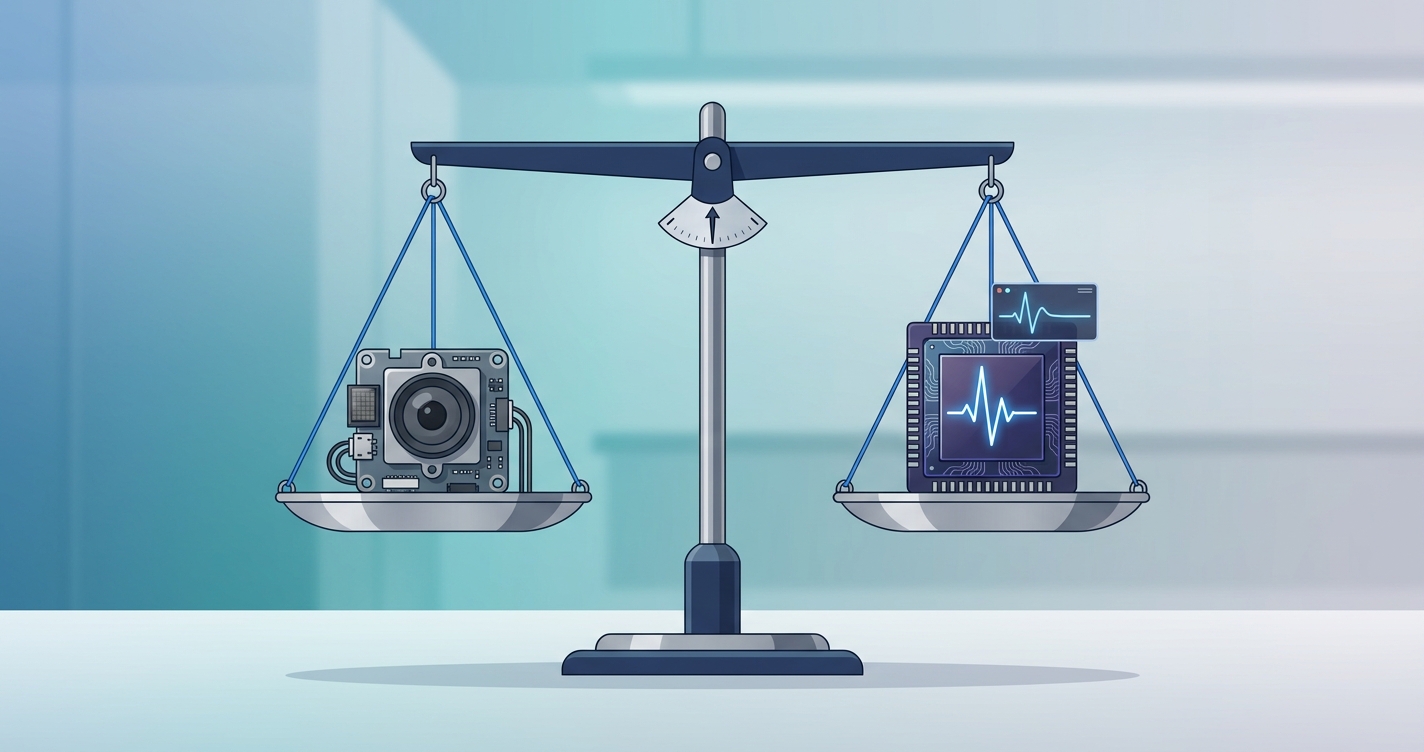
Every hardware team adding contactless heart rate or respiration sensing eventually reaches the same fork in the roadmap: license a generic vitals engine that already exists, or commission a model trained against the exact camera and operating conditions of the product. The custom vs off-the-shelf vitals model decision looks at first like a simple procurement question, but it quietly sets the ceiling on accuracy, the ownership of intellectual property, and the cost curve for the entire product lifecycle. For OEMs, automotive Tier-1 suppliers, and IoT device makers shipping at volume, getting this wrong is expensive to unwind after silicon is locked.
A 2024 benchmark of deep-learning rPPG models for automotive applications by Wang and colleagues, published through CVF Open Access, found that models trained on standard public datasets lose substantial accuracy when moved to in-cabin near-infrared cameras they were never tuned for, with error rates climbing well outside clinical tolerance under real driving illumination.
Framing the custom vs off-the-shelf vitals model decision
Remote photoplethysmography (rPPG) extracts a blood-volume pulse from tiny color and intensity changes in skin pixels. The signal is faint to begin with, and how it appears depends almost entirely on the sensor: spectral response, frame rate, rolling versus global shutter, compression, exposure control, and whether the camera is RGB, infrared, or thermal. An off-the-shelf vitals model is trained on whatever cameras and lighting the vendor had during development. A camera-specific vitals model is trained on data captured through your hardware, in your use case, against synchronized clinical ground truth.
The distinction matters because rPPG accuracy does not transfer cleanly. A generic model assumes a generic camera. The moment your bill of materials specifies a low-cost CMOS module, an 850nm infrared illuminator, or an aggressive H.264 codec, the assumptions the licensed model was built on stop holding. Reviews of deep-learning rPPG, including the 2024 survey by Cheng and colleagues in Frontiers, repeatedly identify illumination variation, motion artifacts, skin-tone diversity, and sensor differences as the dominant sources of error. Each of those is something a custom build can address with targeted training data and a licensed model generally cannot.
This is less a debate about software quality and more about distribution shift. The build vs buy health sensing question is really: how far is your deployment from the conditions the model already knows?
Side-by-side comparison
The table below frames the trade-offs product teams weigh most often when evaluating embedded health monitoring AI options.
| Dimension | Off-the-Shelf Licensed Model | Custom Camera-Specific Model |
|---|---|---|
| Accuracy on your hardware | Variable; tuned for the vendor's reference cameras, not yours | Optimized for your exact sensor, optics, and lighting |
| Time to first integration | Fast, often weeks via SDK or API | Slower upfront; data collection and training cycle |
| Upfront cost | Low entry, license or per-unit fee | Higher initial engineering investment |
| Long-term cost at volume | Recurring royalties scale with units shipped | Front-loaded, then marginal cost approaches zero |
| IP ownership | Vendor retains the model and weights | You can own or exclusively license the trained model |
| Edge and embedded fit | Generic footprint, may exceed MCU or SoC budget | Sized to your compute and power envelope |
| Handling of edge cases | Fixed; you wait for vendor updates | You set the validation targets and retrain |
| Differentiation | Same engine your competitors can license | Defensible, hardware-matched capability |
No single column wins outright. The right answer depends on volume, the gap between your camera and a reference camera, and how central the vitals feature is to the product.
When off-the-shelf is the rational choice
Licensing makes sense in several situations:
- You are building a prototype or proof of concept and need a reading on screen this quarter.
- Your camera closely matches a common reference, such as a standard RGB webcam in good lighting.
- Volumes are low enough that recurring per-unit fees never overtake a build investment.
- Vitals are a secondary, nice-to-have feature rather than a core claim.
- You have no path to collecting labeled physiological data.
In these cases the speed and low entry cost of a generic engine outweigh its limits. The risk is treating a prototype-grade decision as a production commitment.
When a custom build pays off
A camera-specific vitals model becomes the stronger option when:
- The deployment camera is unusual: infrared, thermal, low-resolution, wide field of view, or behind tinted glass.
- Operating conditions are hostile, such as a moving vehicle cabin, dim nursery, or variable retail lighting.
- Vitals accuracy is a headline claim tied to safety, compliance, or regulatory requirements.
- Annual volumes are high enough that per-unit royalties dominate total cost.
- Owning the IP matters for valuation, defensibility, or freedom to operate.
Industry Applications
Automotive driver monitoring
In-cabin systems run on infrared cameras under rapidly shifting sunlight, vibration, and occlusion from hands and steering wheels. The 2024 automotive rPPG benchmark showed that off-the-shelf models trained on visible-light datasets degrade sharply here. A model trained on the specific IR sensor, mounting geometry, and driving conditions is effectively the only path to readings that hold up against Euro NCAP-aligned expectations.
Smart glasses and wearables
Head-worn cameras see skin at extreme angles and close range, with constant micro-motion. The compute budget is tiny and power is precious. A custom model can be quantized and pruned to fit the available SoC, where a generic engine may simply not run inside the thermal and battery envelope.
Baby monitors and fixed-camera devices
Nursery cameras operate in near-darkness on infrared, observing infant physiology whose heart and respiration rates fall well outside the adult ranges most public datasets cover. Camera-specific training against infant-appropriate ground truth addresses both the sensor and the population mismatch at once.
Clinical kiosks and telehealth
Point-of-care kiosks need readings that survive audit against reference devices. Here the value of owning a validated, hardware-matched model and its evidence trail outweighs the convenience of a licensed black box.
Current research and evidence
The technical case for camera-specific models rests on a consistent finding: rPPG performance is bounded by the match between training conditions and deployment conditions. The 2024 Frontiers review by Cheng and colleagues catalogs illumination, motion, skin tone, and sensor variation as the leading error drivers, all of which a custom dataset can target directly. The CVF automotive benchmark by Wang and colleagues quantified how far accuracy drops when a model meets an unfamiliar in-cabin camera.
The economic evidence comes from the broader build vs buy literature on machine learning. Independent TCO analyses in 2024, including work summarized by Kumo.ai, estimate the true three-year cost of building and maintaining one production ML model at roughly $400,000 to $1.5 million, with ongoing maintenance running 20 to 30 percent of build cost annually. Embedded analytics comparisons put a buy path around $150,000 to $360,000 over three years versus $371,000 to $630,000 to build. The crossover point matters: for high-volume use cases, custom development typically becomes the cheaper option somewhere around 24 months, because recurring per-unit royalties on a licensed model keep accruing while a custom build's marginal cost trends toward zero. For a device shipping hundreds of thousands of units, the royalty line crosses the build line well before end of life.
The synthesis is straightforward. Off-the-shelf wins on speed and low commitment. Custom wins on accuracy under non-standard conditions and on cost at scale, while handing you the IP.
The Future of camera vitals model strategy
Three shifts are reshaping the build vs buy calculus. First, training pipelines are maturing, shrinking the data volume and calendar time a custom build once demanded and softening the main objection to building. Second, regulators and safety bodies are tightening expectations for in-cabin and medical sensing, which raises the bar for accuracy and traceable validation that generic engines struggle to clear. Third, as contactless vitals become a standard feature rather than a novelty, a licensed engine your competitors can also license stops being a differentiator. The strategic center of gravity is moving toward hardware-matched models that teams own. Expect more product roadmaps to start with a licensed engine for validation, then transition to a custom build before mass production.
Frequently asked questions
Is a custom vitals model always more accurate than an off-the-shelf one?
Not automatically, but it has a structurally higher ceiling on your hardware. A licensed model is tuned for the vendor's reference cameras. When your sensor, optics, or lighting differ, accuracy drops. A custom model is trained on your exact conditions, which is why the gap widens as your deployment moves further from a standard well-lit RGB setup.
At what volume does building become cheaper than licensing?
It depends on per-unit royalties and build scope, but ML cost analyses commonly place the crossover near 24 months for high-volume programs. Recurring fees on a licensed model scale with every unit shipped, while a custom build is front-loaded and then has near-zero marginal cost. Map your shipment forecast against both curves to find your specific break-even.
Who owns the model in each path?
With licensing, the vendor retains the model and its weights, and you operate within the agreement's terms. With a custom build, you can negotiate to own or exclusively license the trained model, which protects valuation, defensibility, and freedom to operate.
Can we start off-the-shelf and switch to custom later?
Yes, and many teams do. A licensed engine is useful for fast prototyping and feature validation, then a camera-specific build replaces it before mass production once volume and accuracy requirements justify the investment. Specify the camera early so the transition does not require hardware rework.
Circadify is working on this exact problem, training rPPG models optimized for the specific camera, sensor, and use case a device actually ships with rather than a generic reference rig. Product teams weighing the custom vs off-the-shelf vitals model decision can start a custom build inquiry at circadify.com/custom-builds to scope accuracy targets, IP terms, and the cost curve against their own volume forecast.