Will my car's camera really detect my drowsiness before I even feel tired?
How car camera drowsiness detection moves beyond eye tracking to read vital signs, and what that means for automotive Tier-1 suppliers building driver state AI.
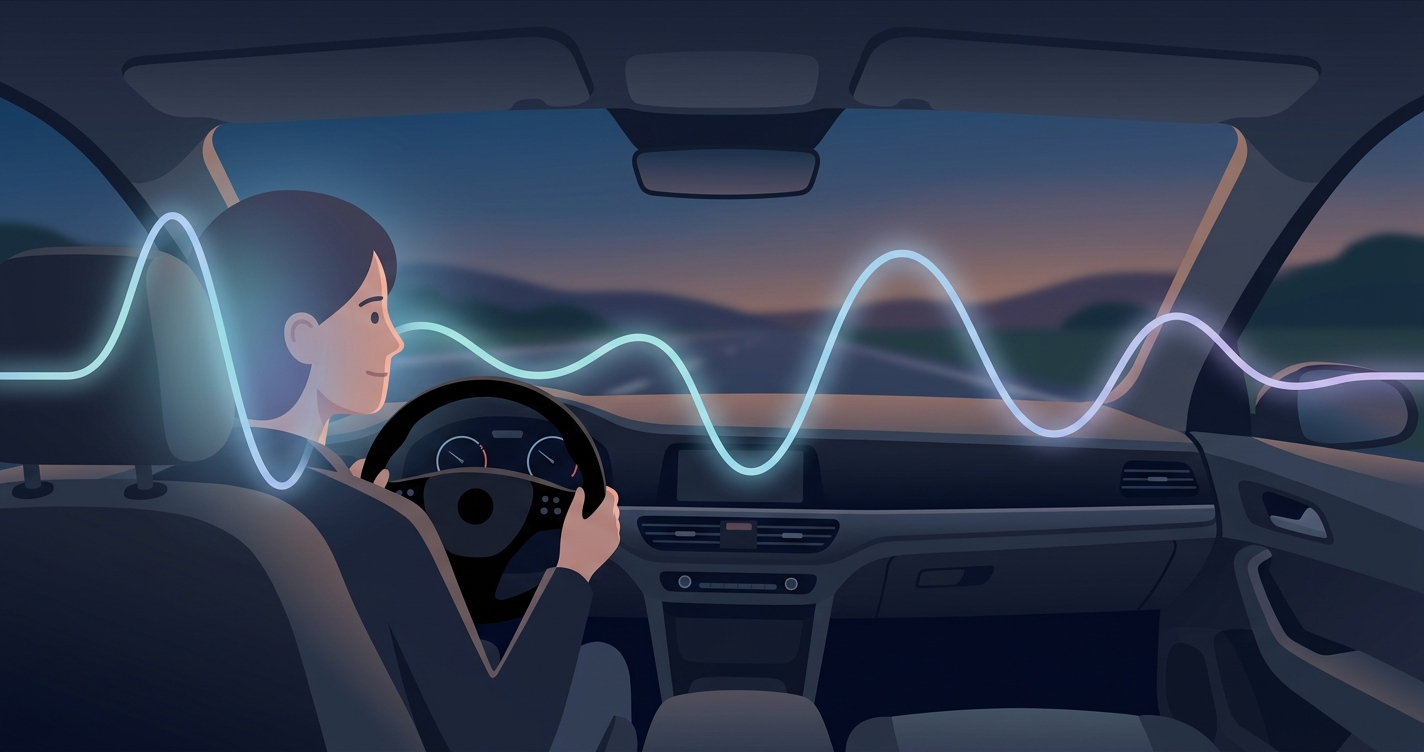
A driver who genuinely feels alert can already be physiologically compromised. The autonomic shift toward sleep begins minutes before the conscious sensation of tiredness arrives, which is exactly why the question of whether a car camera drowsiness detection system can flag fatigue ahead of the driver's own awareness is more than marketing. For automotive Tier-1 suppliers, it reframes the in-cabin camera from a gaze tracker into a passive physiological sensor, and it changes the engineering brief from "did the eyes close" to "did the nervous system already start the descent toward sleep."
An estimated 17.6% of fatal crashes between 2017 and 2021 involved a drowsy driver, accounting for 29,834 deaths, according to an imputation model published by the AAA Foundation for Traffic Safety (2023).
That figure dwarfs the 693 drowsy-driving fatalities NHTSA recorded for 2022 through police reports, and the gap is the entire commercial opportunity. Drowsiness is chronically underdetected because it is hard to see from the outside until the moment of failure. A system that reads internal state, rather than waiting for an external symptom, addresses the part of the problem current methods miss.
What car camera drowsiness detection actually measures
Most production driver monitoring systems today rely on visual behavioral cues: PERCLOS (the percentage of time the eyes are closed), blink rate and duration, head pose, and yawning. These are reliable lagging indicators. By the time PERCLOS climbs, the driver is already in a dangerous state. The forward-looking promise of car camera drowsiness detection is the addition of camera-derived physiology through remote photoplethysmography (rPPG), which extracts a blood-volume pulse waveform from subtle color changes in facial skin.
From that waveform a model can derive heart rate and, more importantly, heart rate variability (HRV). The research on autonomic transitions is consistent: as a person drifts toward sleep, parasympathetic activity rises and the sympathetic-parasympathetic balance shifts. Studies of the wake-sleep transition report decreased RMSSD and a changing LF/HF ratio well before sleep onset, and work by groups analyzing total sleep deprivation has shown HRV can estimate sleepiness-related decrements in psychomotor vigilance. In other words, the heart signals the descent before the eyelids do.
The engineering distinction between behavioral and physiological signals matters for any supplier writing a requirements document:
| Signal type | Example metrics | Lead time vs. event | Hardware demand | Lighting sensitivity |
|---|---|---|---|---|
| Behavioral (visual) | PERCLOS, blink duration, head nod, yawn | Late, near event onset | Standard DMS IR camera | Moderate, robust in NIR |
| Physiological (rPPG) | Heart rate, HRV, respiration | Earlier, tracks autonomic shift | Higher SNR camera, stable framerate | High, sensitive to flicker and exposure |
| Steering/lane (indirect) | Steering entropy, lane drift | Variable, speed dependent | No camera needed | Not applicable |
| Fusion (visual + rPPG) | Combined confidence score | Earliest reliable | Tuned camera plus models | Managed by model design |
The takeaway is that no single channel is sufficient. Behavioral cues are robust but late. Physiological cues are early but fragile against the optical realities of a moving cabin. The strongest systems fuse them, and the fusion only works when the physiological model is trained against the specific camera that will ship.
Why the camera, not just the algorithm, decides the outcome
The hard truth for Tier-1 integrators is that rPPG performance is bound to the sensor. A model trained on a clean RGB dataset will not transfer cleanly to an automotive near-infrared (NIR) DMS camera running at a fixed framerate under a rolling shutter, with active IR illumination and aggressive auto-exposure. The pulse signal in NIR is weaker than in green-channel visible light, and cabin conditions stack additional noise.
Key variables that degrade an off-the-shelf model in a vehicle:
- NIR illumination, which carries a smaller pulsatile component than visible green light.
- Rapidly changing ambient light from tunnels, dappled tree shade, and low-angle dawn sun.
- Vibration and head motion that introduce artifacts at frequencies overlapping the pulse band.
- Auto-exposure and gain control that alter pixel intensities independently of blood flow.
- Skin-tone diversity, which shifts the reflectance characteristics the model must generalize across.
Each of these is a reason a generic algorithm underperforms and a camera-specific vitals model earns its keep. Training an embedded health monitoring AI on data captured through the exact sensor, optics, and illumination stack that will reach production is what closes the gap between a lab demo and a system that survives a 6:40 AM commute.
Industry applications for embedded health monitoring AI
Regulatory compliance and safety ratings
Euro NCAP's 2026 protocols make direct driver monitoring effectively mandatory for a five-star rating, with drowsiness detection required at speeds at or above 50 km/h and benchmarked against a Karolinska Sleepiness Scale level of 7 or higher. The Driver Engagement category can contribute up to 25 points to the overall score. Physiological sensing gives suppliers a path to detect the KSS-7 state earlier and with higher confidence than gaze metrics alone.
Fleet and commercial vehicles
Commercial fleets carry concentrated fatigue risk because of long shifts and night driving. The AAA data notes drowsy crashes cluster between midnight and 6 AM. An rPPG-enabled cabin camera that flags rising parasympathetic dominance can trigger break recommendations before a microsleep, and the same camera stream supports duty-of-care logging without adding a wearable to every driver.
Shared mobility and software-defined vehicles
As cabins become reconfigurable and seats swivel, a passive optical sensor that needs no contact and no driver enrollment fits the architecture better than a steering-wheel or wearable approach. The IoT health sensing model running on the cabin compute can serve drowsiness, stress, and occupant wellness from one data source.
Current research and evidence
The physiological case is well supported. Research on the relationship between autonomic activity and daytime sleepiness, including work published through Oxford University Press journals, links sleepiness to measurable parasympathetic and sympathetic shifts. A systematic review and meta-analysis in Frontiers documented that sleep deprivation reliably alters HRV, with increased LF power and decreased RMSSD. Review work cataloged in the sensor literature, such as the survey of physiological features in drivers' drowsiness detection, places HRV alongside PERCLOS and blink dynamics as a core marker class.
What remains an engineering problem rather than a scientific one is extracting these markers reliably from a camera in motion. HRV in particular demands accurate beat-to-beat interval estimation, which is far more sensitive to noise than a simple averaged heart rate. This is the frontier where camera-specific training, careful signal processing, and sensor fusion separate a usable product from a promising prototype. The evidence says the information is present in the facial blood-volume signal. Capturing it through automotive-grade NIR hardware under real lighting is the work.
The future of car camera drowsiness detection
The trajectory points toward fusion systems where a single in-cabin camera feeds both behavioral and physiological models, producing a continuous driver-state confidence score rather than a binary alarm. Expect three developments to mature together:
- Earlier intervention windows, as HRV-trend models flag autonomic drift minutes ahead of eyelid metrics.
- Multi-parameter driver state, combining drowsiness, cognitive load, and stress from one sensor.
- On-device inference, with models quantized to run on existing cabin compute to satisfy latency and privacy constraints.
The differentiator will not be access to rPPG techniques, which are increasingly published, but the discipline of optimizing the model for one specific camera and validating it against clinical-grade ground truth. Suppliers who treat the camera and the model as a co-designed pair will ship systems that perform; those who bolt a generic algorithm onto an arbitrary sensor will keep explaining why it works in the demo room and not at dawn.
Frequently asked questions
Can a camera really detect drowsiness before the driver feels tired? The physiological basis exists. Autonomic changes such as rising parasympathetic activity and falling HRV appear during the wake-sleep transition, before the conscious sensation of fatigue. A camera that extracts these markers through rPPG can, in principle, flag the descent earlier than behavioral cues like eye closure. Reliable real-world performance depends heavily on the camera and the model trained for it.
How is this different from existing eye-tracking driver monitoring? Eye tracking measures behavioral symptoms such as PERCLOS, blink duration, and head nods, which appear late in the fatigue process. rPPG adds physiological signals like heart rate and heart rate variability that track the autonomic shift toward sleep. The most capable systems fuse both, using physiology for early warning and behavior for confirmation.
Why does the model need to be trained for our specific camera? The pulse signal in skin is faint, and automotive NIR sensors, rolling shutters, fixed framerates, active illumination, and auto-exposure all alter it. A model trained on generic RGB video does not transfer to that hardware. Training on data captured through your exact sensor and optics stack is what makes heart rate and HRV extraction accurate enough for safety use.
Does physiological drowsiness detection help with Euro NCAP 2026? The 2026 protocols require drowsiness detection at 50 km/h and above, benchmarked to a Karolinska Sleepiness Scale level of 7, within a Driver Engagement category worth up to 25 points. Physiological sensing offers a route to detect that state earlier and more confidently than gaze metrics alone, supporting a stronger five-star case.
Circadify is working with hardware teams on exactly this problem: building custom-trained rPPG models optimized for a specific automotive camera, sensor, and cabin environment rather than forcing a generic algorithm onto incompatible hardware. If your team is scoping embedded health monitoring AI for driver state, you can start a custom build inquiry at circadify.com/custom-builds.