Can my smart glasses check my heart rate without touching my skin?
Explore the science of remote photoplethysmography (rPPG) and how smart glasses can measure heart rate without skin contact using camera-specific AI models.
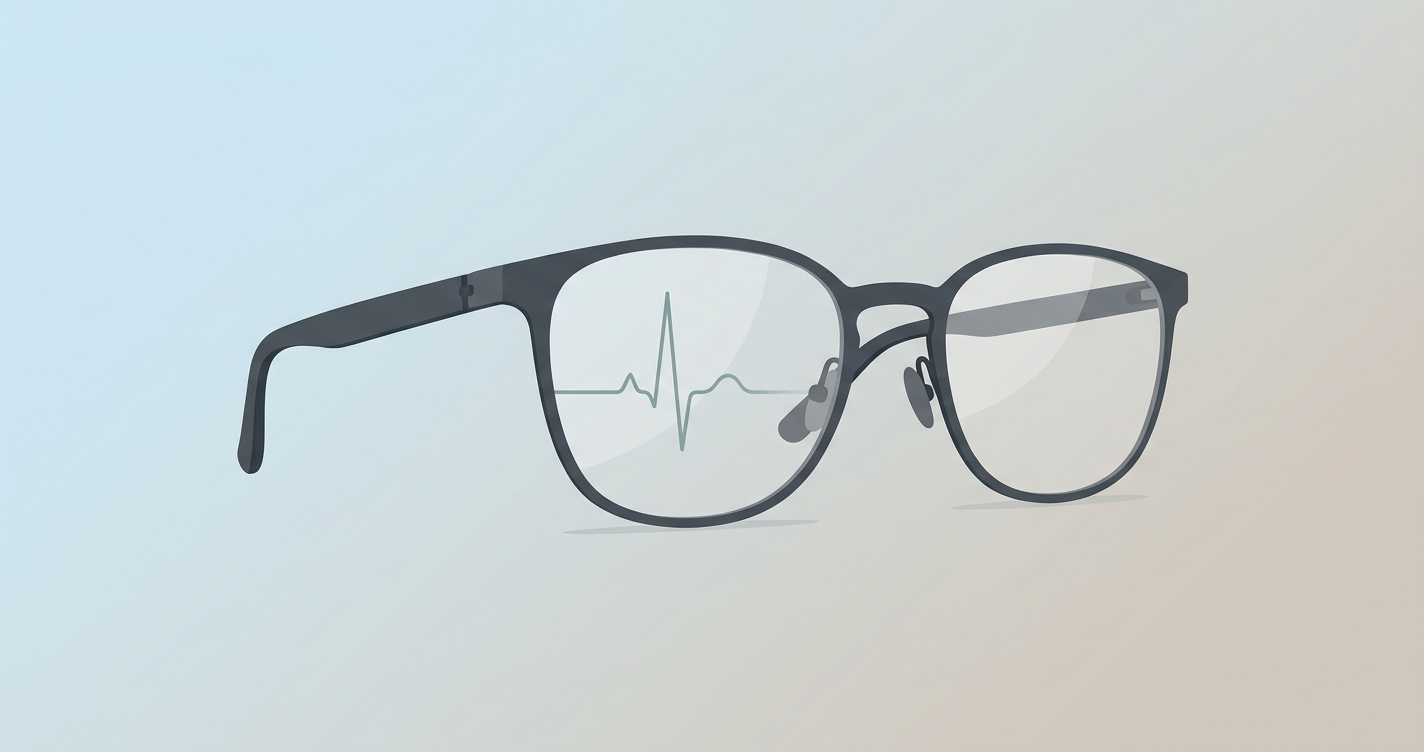
The concept of smart glasses is rapidly evolving from a simple heads-up display to a sophisticated personal health monitoring platform. For hardware OEMs and device makers, the question is no longer if wearables will track vitals, but how they will do it. While wrist-worn devices have normalized contact-based heart rate sensors, a new generation of technology allows for truly passive sensing. This raises a critical question for the future of wearables: is it possible for smart glasses to check your heart rate using only a camera, without any part of the device touching your skin? The answer is yes, and it is achieved through a combination of advanced optics and specialized, camera-aware machine learning models.
"The global market for smart wearables is projected to reach over $186 billion by 2030, with a growing demand for devices that integrate seamless, passive health monitoring capabilities." - Grand View Research, 2023
The science of no-contact heart rate sensing
The technology that enables smart glasses heart rate no contact measurement is called remote photoplethysmography (rPPG). Unlike traditional photoplethysmography (PPG) which uses light emitters and sensors in direct contact with the skin (e.g., on the back of a smartwatch), rPPG uses a standard digital camera to do the same job from a distance. The underlying principle is the same: to measure the volumetric changes in blood flowing through your arteries.
Here's how it works:
- Light and Skin Reflectance: Human skin is translucent. When light hits the skin, some of it is absorbed and some is reflected.
- Blood Volume Pulse: With every heartbeat, a pressure wave travels through your circulatory system, causing the tiny blood vessels (capillaries) in your skin to expand and contract.
- Detecting Micro-Changes: Hemoglobin in your blood absorbs certain wavelengths of light. As the volume of blood in your capillaries changes, the amount of light reflected back to a camera also changes. These changes are invisible to the naked eye.
- Signal Extraction: A sophisticated computer vision model analyzes the video feed from the smart glasses' camera, focusing on specific regions of interest on the face (like the cheeks or forehead). By detecting these microscopic, cyclical changes in skin color, the algorithm can reconstruct the user's blood volume pulse and calculate their heart rate.
However, the real engineering challenge lies in making this work on a tiny, head-worn camera. The signal is incredibly subtle and easily disrupted by noise. This is why a generic algorithm designed for a high-resolution smartphone camera will fail when deployed on the specialized camera hardware of smart glasses.
Comparison: contact vs. contactless heart rate sensing
| Feature | Contact-Based PPG (Smartwatches) | Remote PPG (Smart Glasses) |
|---|---|---|
| Sensing Method | LED shines light into the skin; a photodiode measures reflected light. | A passive camera observes changes in skin color under ambient light. |
| Required Contact | Yes, sensor must be snug against the skin. | No, works from a short distance. This is smart glasses heart rate no contact. |
| Hardware | Dedicated LEDs and photodiode sensors. | Standard RGB or IR camera sensor already present in the device. |
| Primary Challenge | Signal quality depends on skin contact, sweat, and fit. | Signal is highly susceptible to motion (head movement) and lighting changes. |
| Power Consumption | Active illumination from LEDs consumes power. | Primarily software-based; power draw is from the camera and processor. |
| Model Specificity | Algorithms are tuned to the specific sensor hardware. | Requires a highly specialized model trained for the device's exact camera and optics. |
Why smart glasses need custom-trained rPPG models
The performance of an rPPG system is fundamentally tied to the camera it uses. A model trained on a dataset captured with one type of camera learns the specific noise characteristics, color filter array, and lens properties of that device. When you deploy that same model on a different camera, its accuracy degrades significantly.
This is especially true for smart glasses, which feature unique hardware constraints:
- Miniaturized Optics: The tiny cameras in smart glasses have different lens distortion, focal lengths, and sensor sizes compared to smartphone cameras.
- Proximity and Field of View: The camera is positioned very close to the user's face, creating a different perspective and field of view than a phone held at arm's length.
- Motion Artifacts: As highlighted in research from institutions like the University of Oxford, head-mounted cameras are subject to constant, complex motion artifacts that are distinct from the motion patterns of a smartphone. A 2022 review in the journal Sensors emphasized that mitigating these artifacts is the primary challenge for wearable rPPG.
Because of these factors, achieving reliable performance requires building a custom rPPG model. This involves collecting a dedicated training dataset using the actual smart glass hardware and developing a neural network architecture that is optimized for that specific camera's data stream.
Current research and evidence
The field of rPPG is an active area of academic and commercial research. Studies have successfully demonstrated the feasibility of camera-based vital signs monitoring, but they consistently point to the challenge of generalization across different devices and conditions. A paper titled "Promoting Generalization in Cross-Dataset Remote Photoplethysmography" (2022) explored how models often fail when moving from a lab dataset to a real-world application, a problem known as "domain shift."
Researchers are actively working on techniques to make rPPG models more robust. For example, work by Hassan Abbas of the University of Dayton (2021) focused on advanced signal processing to separate the weak blood-pulse signal from noise caused by head motion and lighting variations. The consensus in the research community is that sensor-specific model calibration is not just beneficial but essential for any production-grade rPPG deployment on a new piece of hardware like smart glasses.
The future of embedded health sensing
The ability to measure heart rate without contact is just the beginning. As camera-specific models become more powerful and efficient, smart glasses and other IoT devices will be able to derive a much richer set of physiological data. This includes respiratory rate, heart rate variability (HRV), and potentially even blood pressure trends and blood oxygen saturation. For hardware OEMs, integrating this capability offers a significant differentiator in a crowded market, moving the device from a simple accessory to a vital tool for wellness and safety.
Frequently asked questions
-
Is a special camera needed for this to work?
-
Not necessarily. The technology can work with standard RGB cameras found in many consumer devices. However, the AI model must be specifically trained and optimized for that exact camera sensor. Infrared (IR) cameras, also common in wearables, can also be used and often perform better in low-light conditions.
-
How accurate is heart rate measurement from a camera?
-
The accuracy depends almost entirely on the quality and specificity of the rPPG model. A generic, one-size-fits-all model will be highly inaccurate. A custom-trained model that is built for the specific smart glass hardware can achieve a high degree of accuracy, comparable to consumer-grade optical heart rate sensors.
-
Does this work in low light or at night?
-
Performance in low light is a challenge for RGB camera-based rPPG. However, if the smart glasses are equipped with an IR camera and IR illumination (often used for eye-tracking or facial recognition), rPPG can be trained to work reliably even in complete darkness.
The journey to create truly intelligent, health-aware wearables depends on solving complex engineering problems. The variability between cameras is one of the biggest hurdles for passive vital signs monitoring. Circadify specializes in building these camera-specific, custom-trained rPPG models for hardware OEMs. If you are a device maker looking to integrate robust, no-contact vital signs monitoring into your smart glasses or other camera-equipped products, learn more about our process for custom builds at circadify.com/custom-builds.