
Can my car really tell if my heart is racing while I drive?
A deep dive into how in-cabin cameras use rPPG to measure driver heart rate, the technical challenges, and why custom-trained models are essential for accuracy.
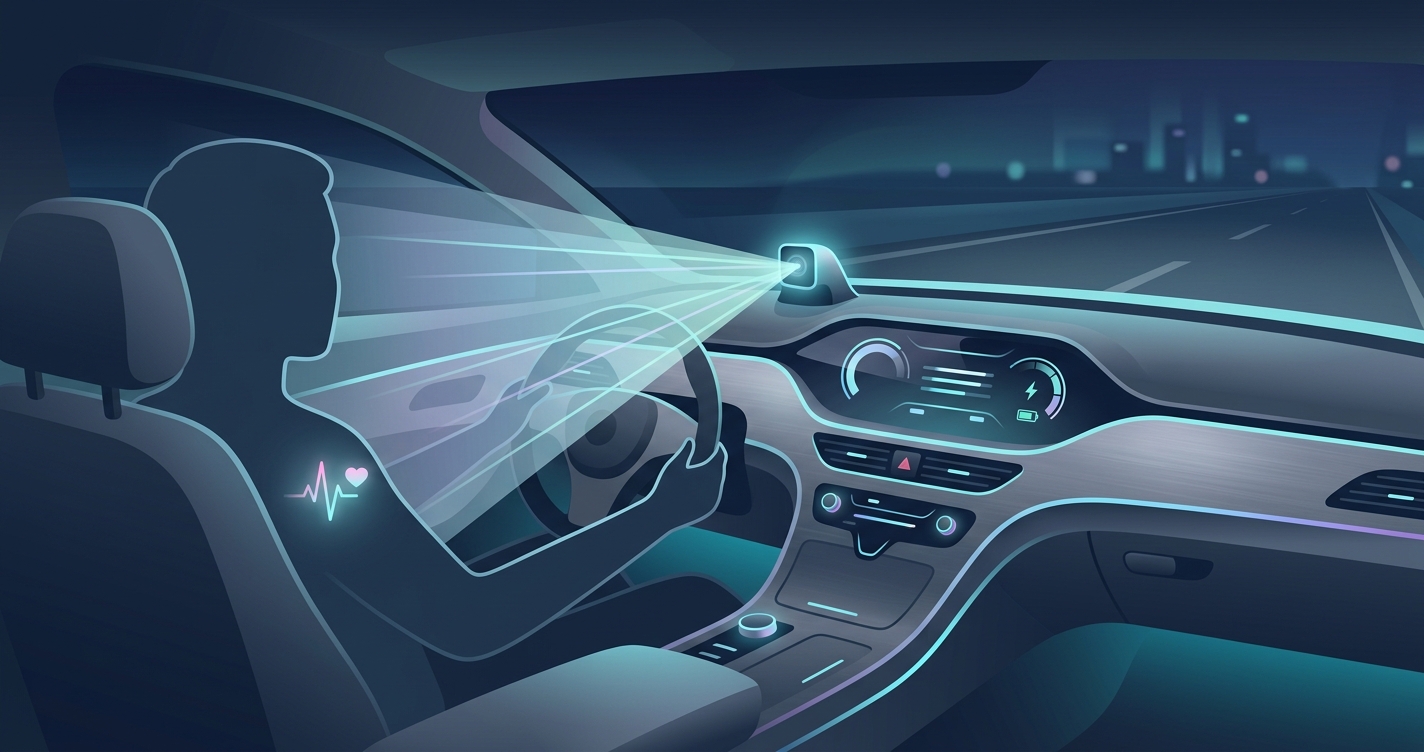
The rise of the software-defined vehicle has transformed the automotive cabin from a simple cockpit into a highly-monitored environment. Driven by safety mandates from regulators like the Euro NCAP, driver monitoring systems (DMS) are now a standard feature, primarily using cameras to track head position, eye-gaze, and signs of drowsiness. But for automotive OEMs and Tier-1 suppliers, the question is shifting from "Is the driver paying attention?" to "Is the driver okay?". This evolution requires moving beyond simple visual tracking to physiological monitoring. The most promising technology for this is remote photoplethysmography (rPPG), a technique that allows a simple camera to measure a driver's heart rate without any contact. But can it really work amidst the vibrations, changing light, and constant motion of a real-world driving environment?
A comprehensive systematic review published in 2024 analyzing the use of rPPG in driver monitoring identified 344 relevant studies. The researchers noted that deep learning algorithms have significantly improved the accuracy of rPPG signal extraction, but significant challenges remain in achieving consistent detection under the dynamic conditions of driving.
How a car camera can measure heart rate while driving
The ability for a car camera to measure heart rate while driving hinges on the principle of remote photoplethysmography. This camera-based technique detects the minuscule changes in skin color that occur with every heartbeat. When the heart pumps blood, it flows into the microvascular tissue in the face. Hemoglobin in the blood absorbs light. By illuminating the face (either with ambient light or its own near-infrared source) and recording the reflected light, a camera sensor can detect the subtle reduction in reflected light that corresponds to this blood volume pulse. An algorithm then analyzes the frequency of these changes in the video signal to calculate the person's heart rate and heart rate variability (HRV).
This process is incredibly sensitive. In a controlled environment like a lab, rPPG can be highly accurate. However, the inside of a car is one of the most challenging environments for optical sensing. The primary challenges include:
- Motion Artifacts: Head movements from the driver, even slight ones from checking mirrors or talking, can cause large-scale changes in the video signal that can overwhelm the tiny rPPG signal. Vehicle vibration adds another layer of noise.
- Illumination Variance: The lighting conditions inside a car change constantly. Driving under trees creates a strobe-like effect, entering a tunnel causes a sudden plunge into darkness, and direct sunlight can saturate the camera sensor. These changes dramatically affect the light reflected from the driver's face.
- Camera Specifics: Not all cameras are created equal. The type of sensor (CMOS, IR), the lens, the spectral filters, and its specific placement in the cabin (e.g., in the steering column, dashboard, or rear-view mirror) all determine a unique optical signature. An rPPG model trained on one camera will not perform reliably on another without specific re-training or calibration.
Sensor comparison for in-cabin heart rate monitoring
Choosing the right sensor is a critical decision for any OEM or supplier developing a DMS with physiological sensing capabilities. The performance trade-offs between different camera types are significant.
| Feature | Standard RGB Camera | Near-Infrared (NIR) Camera | Thermal Camera |
|---|---|---|---|
| Principle | Detects reflected ambient light | Detects reflected infrared light from dedicated emitters | Passively detects heat (long-wave infrared) from the body |
| Low-Light Performance | Poor; requires visible light | Excellent; works in complete darkness | Excellent; independent of any light source |
| Robustness to Light | Highly susceptible to changes in ambient visible light | Highly robust to visible light changes, but can be affected by sunlight | Unaffected by visible light, but can be affected by HVAC or open windows |
| Accuracy (State of the Art) | Good in ideal light (MAE can be <4 bpm) but degrades rapidly | Robust in variable light (MAE ~4-6 bpm is achievable) | Less mature for heart rate; primarily used for breathing rate |
| Key Challenge | Extreme variability of ambient light in a car | Signal quality is sensitive to motion artifacts | Lower sensor resolution, higher cost, and noise sensitivity |
| DMS Integration | Already used for basic gaze tracking in some systems | Increasingly the standard for modern, robust DMS | Specialized and higher cost; not typically used for primary DMS |
Industry Applications
For Tier-1 suppliers and OEMs, a reliable car camera measure heart rate driving capability unlocks a new generation of safety and comfort features.
Driver drowsiness and sudden illness detection
A driver's heart rate naturally lowers as they become drowsy. A system that detects a significant drop, especially when combined with metrics like reduced steering input and drooping eyelids, can issue a much more reliable drowsiness alert. Conversely, sudden, unexplained spikes in heart rate could indicate a major medical event like a heart attack or a panic attack, allowing the vehicle to trigger an emergency response.
Stress and cognitive load assessment
Heart Rate Variability (HRV), which can also be derived from the rPPG signal, is a powerful indicator of mental and physiological stress. A vehicle could monitor HRV to assess a driver's cognitive load. If the driver is navigating a complex, high-stress interchange, the system could automatically mute non-critical notifications, creating a safer operating environment.
Personalized in-cabin experiences
The driver's physiological state can become another input for the vehicle's comfort systems. If the rPPG system detects an elevated heart rate and signs of stress, the car could suggest a calmer route, change the ambient lighting to a more soothing color, or adjust the music playlist to something more relaxing. This moves the vehicle from a passive tool to an active partner in the driver's well-being.
Current research and evidence
The field is moving quickly from academic research to production viability. A 2024 systematic review titled "AI Innovations in rPPG Systems for Driver Monitoring" highlighted that while deep learning models are improving accuracy, overcoming motion and illuminance variations remains the primary focus. Research from institutions like the Tokyo Institute of Technology has explored dual-modality RGB-NIR cameras, finding they can achieve a Mean Absolute Error (MAE) as low as 4.45 bpm even with facial motion and under-illumination. This is a critical benchmark for real-world viability. The study also noted that in challenging low-light scenarios, traditional RGB-only methods succeeded for only 25% of subjects, while the NIR-based approach was successful for all subjects. This highlights the necessity of NIR sensors for robust, 24/7 driver monitoring. Further research has pointed to the need for larger, more diverse datasets that capture a wider range of skin tones, ages, and real-world driving conditions to ensure these systems are equitable and reliable for everyone.
The future of automotive biosensing
The integration of rPPG is the first step toward a more comprehensive understanding of driver state. The future lies in sensor fusion, combining the cardiac data from the camera with other available data streams. This could include pressure sensors in the seat to measure respiratory rate, steering wheel sensors detecting grip pressure, or even in-cabin radar detecting the presence of a child left in a car seat. Processing this data in real-time requires powerful, efficient edge computing hardware. However, the core challenge for OEMs remains at the start of this chain: ensuring the initial data from the rPPG sensor is accurate. This is not a software problem that can be solved with a generic, one-size-fits-all model. The unique physics of every camera, lens, and IR emitter combination demands a sensor-specific approach to model training.
Frequently asked questions
How accurate is measuring heart rate with a car camera? Current research shows that in realistic driving conditions, systems using near-infrared cameras can achieve a Mean Absolute Error of around 4-5 beats per minute compared to a medical-grade sensor. Accuracy is highly dependent on the quality of the camera, the sophistication of the algorithm, and the amount of driver motion.
Can this technology work at night or in a dark garage? Yes. This is a primary reason why most automotive manufacturers are using Near-Infrared (NIR) cameras for driver monitoring. These systems use invisible infrared LEDs to illuminate the driver's face, allowing the camera to see and measure heart rate reliably in complete darkness without distracting the driver.
Why can't a carmaker use a standard software model for this? Every camera and lens combination has a unique optical profile that alters the light it captures. Furthermore, its specific placement and angle in the car cabin create a distinct "view" of the driver. A "one-size-fits-all" software model trained on a generic camera will fail to account for these specific hardware variables, leading to poor accuracy and reliability. A custom rPPG model must be trained or fine-tuned on data collected from the exact target hardware to be effective.
The challenge for automotive OEMs and Tier-1 suppliers isn't just about implementing a camera; it's about developing a robust, reliable sensing model that works with their specific hardware choices. Generic models fail under the demanding conditions of a moving vehicle. Circadify specializes in addressing this exact problem, creating custom-trained rPPG models optimized for your unique camera and in-cabin environment. To learn more about a custom build for your driver monitoring system, visit circadify.com/custom-builds.