
7 Reasons Your Camera Vitals Fail Across Skin Tones
Why generic rPPG models misread darker skin tones, the compliance risk it creates, and how camera-specific training closes the accuracy gap for OEMs.
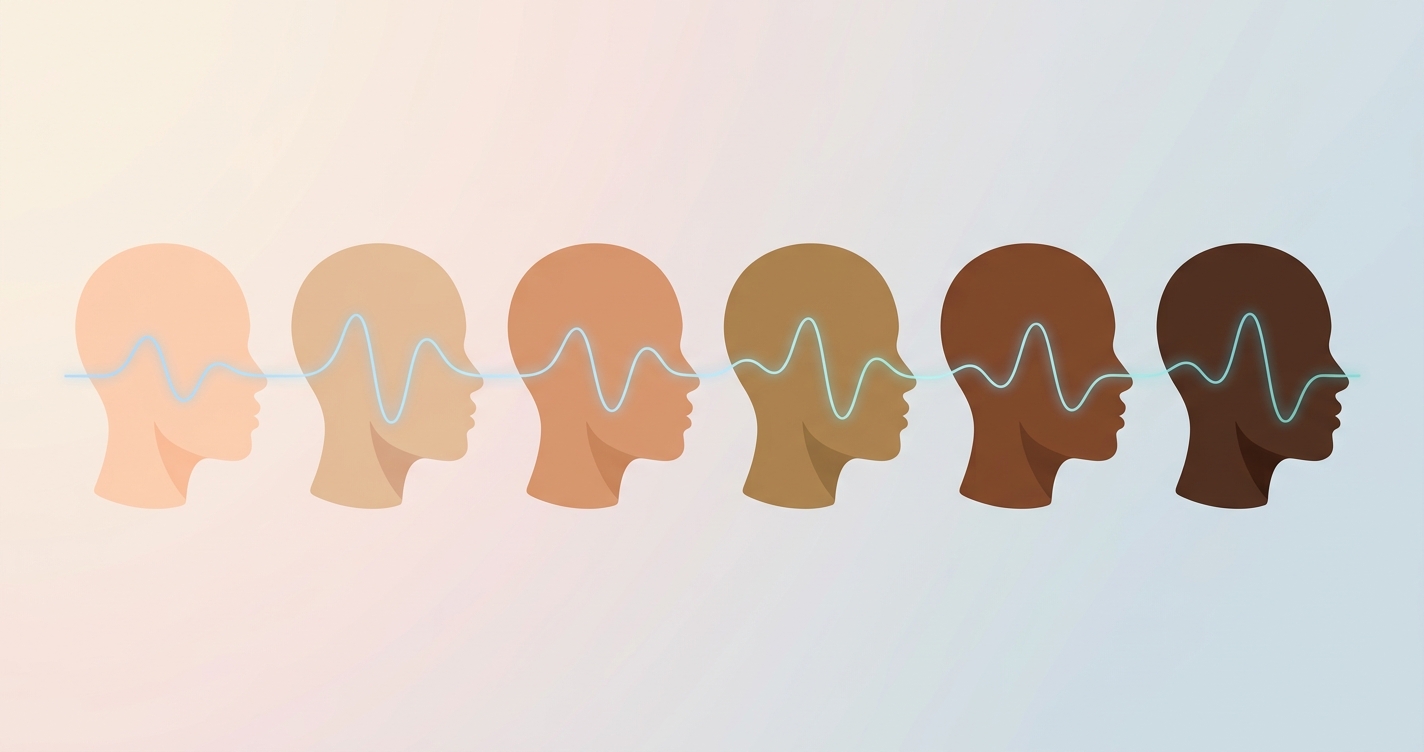
Hardware teams shipping contactless vitals usually discover the skin tone problem late, often during a customer pilot or a regulatory review, when a feature that demoed perfectly in the lab starts returning noisy or absent readings for a portion of real users. The root cause is rarely a single bug. It is a chain of physics, data, and engineering decisions that quietly compound against darker skin. For OEMs, automotive Tier-1 suppliers, and IoT device makers, weak camera vitals accuracy across skin tones is not just a quality issue. It is a compliance exposure, a brand risk, and a product that fails the people it claims to serve. This report breaks down seven reasons one-size-fits-all models misread darker skin, and why camera-specific training is the correction that actually holds up in production.
A 2020 meta-analysis by Ewa Nowara, Daniel McDuff, and Ashok Veeraraghavan found that camera-based heart rate estimation degrades sharply for the darkest skin in Fitzpatrick category VI, while remaining relatively stable across types I through V, exposing a bias built into the algorithms themselves rather than the individuals being measured.
Why camera vitals accuracy across skin tones breaks down
Remote photoplethysmography (rPPG) works by reading tiny color changes in skin as blood volume pulses beneath the surface. The signal is faint to begin with, often a fraction of a percent of the pixel value. Anything that weakens it pushes the measurement toward noise. Melanin is the most consistent attenuator in that chain, but it is far from the only one. The reason camera vitals accuracy across skin tones fails so reliably is that several independent factors all bend in the same direction, and a generic model trained on a narrow population never learns to compensate for any of them.
Here are the seven reasons, grouped from physics through engineering to process:
- Melanin absorbs more of the green and visible light that rPPG depends on, lowering the signal-to-noise ratio before any algorithm runs.
- Public training datasets skew heavily toward lighter skin, so models learn what they are shown and overfit to it.
- A single global model averages across the population and optimizes for the majority, letting minority subgroups absorb the error.
- Camera auto-exposure, gain, and white balance are frequently tuned for lighter skin, clipping or under-exposing darker faces.
- Aggressive video compression and naive region-of-interest selection discard the weak pulse signal first.
- Reported accuracy is often a single aggregate number that hides subgroup failure entirely.
- Sensor and wavelength choices ignore the physics of melanin, so the hardware itself starts at a disadvantage.
The compliance angle OEMs cannot ignore
The fear driving procurement conversations is not abstract. In a 2020 study published in the New England Journal of Medicine, Michael Sjoding and colleagues at the University of Michigan found that pulse oximetry missed low blood oxygen nearly three times more often in Black patients than in White patients. That finding reframed device bias as a patient-safety and equity issue, and it set a precedent regulators and buyers now apply to any optical health sensor. A camera vitals feature that quietly performs worse for darker skin carries the same category of risk, and a single aggregate accuracy figure will not survive scrutiny.
How generic and camera-specific models compare
The difference between a licensed one-size engine and a custom-trained, camera-specific model shows up most clearly when you separate performance by skin tone instead of reporting a blended average.
| Factor | Generic One-Size Model | Camera-Specific Custom Model |
|---|---|---|
| Training population | Skewed toward light skin, public datasets | Balanced across Fitzpatrick I to VI for your sensor |
| Sensor assumptions | Built for an unknown average camera | Tuned to your exact CMOS, IR, or thermal sensor |
| Auto-exposure handling | Inherits camera defaults | Calibrated for darker skin under your lighting |
| Performance reporting | Single aggregate accuracy | Per-subgroup error broken out by skin tone |
| Darkest skin (type VI) | Largest error, frequent dropouts | Error gap measured and minimized |
| Compliance posture | Hard to defend in audit | Documented subgroup evidence |
| Failure mode | Silent under-performance | Known, bounded, and validated |
The table makes the core point: fairness is not a setting you toggle on a generic model. It is a property that has to be designed in through the data the model sees and the camera it is trained against.
Industry applications where the gap bites hardest
Skin tone bias is not evenly distributed across products. It concentrates wherever the camera, lighting, and population are least controlled, which is to say most real deployments.
Automotive driver monitoring
In-cabin cameras face the worst possible conditions: harsh side lighting, rapid exposure swings, infrared illumination at night, and a global population of drivers. A driver monitoring system that cannot read heart rate or respiration for darker-skinned drivers fails its safety mandate for exactly the users it must protect. As Euro NCAP protocols tighten, subgroup performance becomes a homologation question, not a nice-to-have.
Smart mirrors, kiosks, and home health
Bathroom mirrors and pharmacy kiosks promise quick wellness checks to everyone who steps in front of them. When the progress bar stalls or returns a wrong number for darker skin, the product breaks trust at the moment it is supposed to build it. These fixed-camera deployments often run cheap sensors with aggressive compression, two of the seven factors above stacked together.
Wearables, glasses, and IoT sensors
A 2024 analysis of contact photoplethysmography in smartwatches found measurable bias in diverse skin tones even with skin contact, which means camera-based sensing at a distance starts from a harder position. Smart glasses and ambient IoT sensors with small, low-power cameras have the least signal to spare, so the melanin penalty hits them first.
Current research and evidence
The literature now points clearly toward training data and model design as the fix rather than physics being an immovable ceiling. The Nowara, McDuff, and Veeraraghavan meta-analysis established that the degradation for type VI skin is an algorithmic artifact, not an inevitability, since performance was stable across the other five categories. A separate line of work on demographic bias in public rPPG datasets documented how underrepresentation of darker skin in benchmark data propagates straight into deployed models, because a model cannot generalize to populations it never saw.
Researchers are also showing concrete remedies. A UCLA team led by work from Krish Kabra and colleagues introduced Diverse R-PPG, demonstrating that deliberately balanced training across skin tones and scenes narrows the heart-rate error gap. More recent methods such as PhysFlow, published on arXiv, use skin-tone transfer through conditional normalizing flows to synthetically expand representation of darker skin in training, directly attacking the data scarcity problem. The common thread across these studies is that custom vital signs algorithm fairness comes from intervention at the data and training stage, not from a post-hoc filter applied to a generic engine.
Two practical takeaways follow for hardware teams:
- A diverse training data vitals model is the single highest-use decision, because it determines the ceiling every downstream step inherits.
- Contactless heart rate bias must be measured per subgroup during validation, since aggregate accuracy mathematically hides the failure.
The future of camera vitals fairness
The direction of travel is toward camera-specific models with documented subgroup evidence as a baseline expectation. Three shifts are already underway. First, regulators and large buyers increasingly ask for disaggregated performance data, mirroring the post-2020 reckoning over pulse oximetry. Second, multi-wavelength and infrared sensing is being paired with rPPG to capture signal where melanin absorbs less visible light, turning sensor choice from a liability into an advantage. Third, synthetic and augmented data pipelines are maturing to the point where balanced representation no longer requires recruiting thousands of subjects per skin tone, lowering the cost of building fairness in from the start. The teams that treat skin tone performance as a design requirement, rather than a defect to patch, will be the ones whose products pass audit and earn trust across their full user base.
Frequently asked questions
Why does darker skin reduce camera vitals accuracy? Melanin absorbs more of the green and visible light that rPPG relies on to detect blood-volume changes. That lowers the signal-to-noise ratio before any software runs. The effect is real physics, but research shows that balanced training data and the right sensor choice can largely compensate for it, so the failure is fixable rather than fundamental.
Is this a regulatory or compliance problem for OEMs? Increasingly, yes. After a 2020 New England Journal of Medicine study found pulse oximeters underestimated low oxygen in Black patients far more often, buyers and regulators began expecting optical health sensors to report performance broken out by skin tone. A single aggregate accuracy number is difficult to defend in an audit when subgroup failure is hidden inside it.
Can a generic off-the-shelf model be made fair with a software update? Only partially. Fairness depends on the population a model was trained on and the camera it was trained against. A filter or threshold change cannot recover signal the model never learned to read. Closing the gap reliably means retraining on balanced data for your specific sensor and lighting conditions.
How do I know if my current model has a skin tone bias? Validate against ground truth with subjects spanning Fitzpatrick types I through VI and report error per subgroup, not as a blended average. If you only have an aggregate accuracy figure, you do not yet know whether a bias exists.
Circadify is building custom-trained rPPG models for the specific camera, sensor, and population each product serves, with subgroup performance measured rather than assumed. If your team needs camera vitals that hold up across every skin tone in your user base, start a custom build inquiry at circadify.com/custom-builds.