
Best IR and Thermal Cameras for In-Cabin Health Sensing
A buyer's guide to IR thermal vitals model camera selection for cabin monitoring, ranking sensor types and the tuned models each one needs.
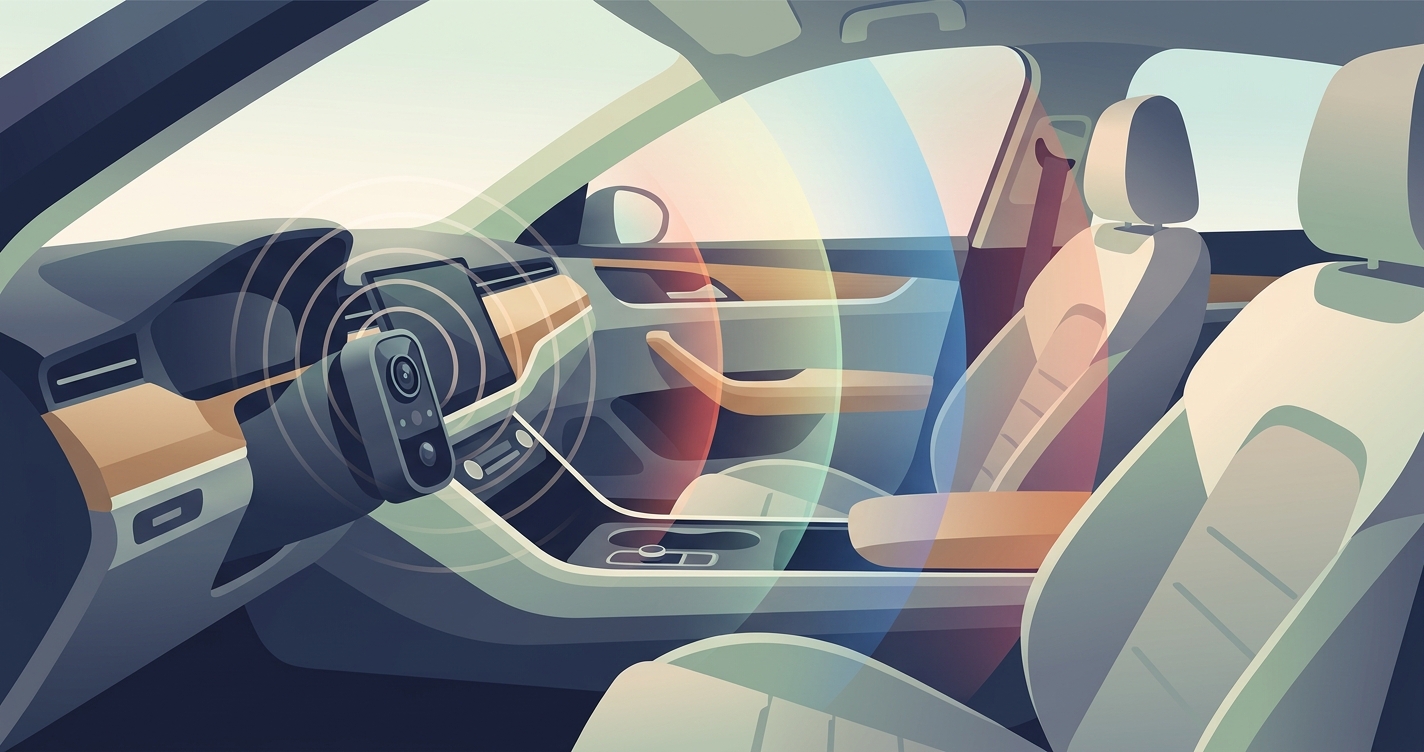
In-cabin sensing has crossed from concept demos into procurement roadmaps, and the camera sitting on the steering column is now expected to do far more than track gaze and head pose. Tier-1 suppliers building toward Euro NCAP child-presence and driver-state requirements increasingly want the same sensor to report heart rate and respiration. That ambition runs straight into a hardware decision that is easy to underestimate: IR thermal vitals model camera selection determines whether contactless vitals are a shippable feature or a perpetual pilot. The sensor you specify decides what physiological signal is physically present in the frame, and no amount of downstream software can recover a signal the optics never captured.
A 2024 in-vehicle study using a near-infrared Time-of-Flight camera reported reliable contactless heart rate and respiration extraction inside a moving cabin, while clinical thermal respiration work has shown mean absolute errors between 0.64 and 0.91 breaths per minute, evidence that the right sensor class can meet automotive-grade expectations.
Ir thermal vitals model camera selection: matching sensor physics to cabin reality
The cabin is one of the most hostile environments for camera-based vitals. Illumination swings from direct dawn glare to total darkness in a tunnel, occupants move constantly, and the only acceptable mounting points are off-axis and several feet from the face. These constraints push selection away from conventional visible-light imaging and toward infrared and thermal sensors, but the two operate on completely different physics.
Near-infrared (NIR) and short-wave imaging still rely on reflected light. With active 850nm or 940nm illuminators they see the face in darkness and capture the subtle skin-reflectance changes that remote photoplethysmography (rPPG) models convert into a pulse waveform. Thermal long-wave infrared (LWIR) sensors do something fundamentally different: they detect emitted heat. They do not need any illumination at all, and they read respiration directly from the temperature swing around the nostrils and mouth during each breath cycle. As Fraunhofer IMS noted when it presented in-cabin vital-sign algorithms in late 2023, the move toward internal cameras is being driven by regulation, and that regulatory clock is forcing sensor decisions earlier in the design process than most teams expect.
The core trade-off is signal type. NIR carries a clean pulsatile blood-volume signal but a weak respiration signal. LWIR carries an excellent respiration signal but only an indirect, lower-confidence heart-rate signal derived from superficial vessel temperature. Selecting one sensor without deciding which vital sign is primary is the most common and most expensive mistake in this category.
Comparison of cabin vitals sensor types
The table below ranks the main sensor classes against the criteria that matter for an automotive integration program. Each requires a different tuned model approach, and the model effort scales with how indirect the physiological signal is.
| Sensor type | Works in darkness | Heart rate signal | Respiration signal | Cost / cabin fit | Model tuning required |
|---|---|---|---|---|---|
| Visible CMOS (RGB) | No | Strong in good light | Weak | Low cost, poor at night | Moderate, fails low-light |
| NIR active-illuminated | Yes | Moderate to strong | Weak | Moderate, common in DMS | High, illuminant-specific |
| NIR Time-of-Flight (ToF) | Yes | Moderate, depth-assisted | Moderate via chest motion | Higher, adds depth | High, fusion model |
| LWIR microbolometer (8-12um) | Yes | Weak, indirect | Strong, direct thermal | Higher unit cost | High, thermal-specific |
| MWIR cooled thermal | Yes | Moderate | Very strong | Very high, rarely cabin-viable | Specialist, niche only |
A few selection patterns follow directly from this comparison:
- If the program already mounts a NIR driver-monitoring camera, reuse it for heart rate before adding a second sensor. The hardware is paid for; the gap is a tuned model for that exact illuminant and lens.
- If respiration or child-presence breathing detection is the priority, an LWIR microbolometer is the strongest single choice, accepting that pulse will be a secondary, lower-confidence output.
- If both vitals must be high confidence, a NIR-plus-thermal fusion configuration outperforms either sensor alone, at the cost of a more complex model and calibration step.
- MWIR cooled cameras deliver the cleanest thermal signal but their cost, size, and cooling needs almost always rule them out of production cabins.
Industry Applications
Driver state and drowsiness monitoring
Heart-rate variability and respiration trends are early markers of fatigue, often shifting before a driver consciously feels tired. Here a NIR sensor with a pulse-tuned rPPG model is usually the backbone, because it functions through night driving and tunnel transitions. The model has to be trained on the specific illuminator wavelength and the off-axis geometry of a column or A-pillar mount, not on frontal lab footage.
Occupant and child-presence detection
Regulatory pressure to detect an unattended child has made respiration sensing a safety function, not a comfort feature. LWIR shines here because a sleeping infant in a rear-facing seat presents almost no usable reflectance signal, but the breath-driven thermal signature around the face remains detectable. The tuned model must handle small faces, blankets, and seat occlusion.
Health and wellness cabin features
Premium OEMs are positioning the cabin as a wellness space, surfacing stress and recovery metrics. These features tolerate lower latency pressure but demand consistency across skin tones and seating positions, which again comes back to how the model was trained for that camera rather than the camera alone.
Current research and evidence
The evidence base for cabin-grade thermal and IR vitals has matured quickly. A 2024 study published in MDPI Sensors demonstrated a contactless vital-sign system using a near-infrared Time-of-Flight camera for in-vehicle driver monitoring, extracting both heart rate and respiration despite cabin motion and variable lighting. On the thermal side, work led by researchers including Carlos Lozano and colleagues on overnight clinical respiration monitoring reported mean absolute errors of 0.64 to 0.91 breaths per minute using LWIR cameras, while separate infrared thermography studies combining machine learning achieved breathing-rate errors between 0.607 and 1.259 breaths per minute with agreement indices above 93 percent against contact references.
Georgia Tech researchers reported in March 2025 that advanced processing of thermal images can reliably recover temperature, breathing, and pulse, reinforcing that thermal is no longer respiration-only when paired with the right algorithms. Work by Mickael Causse and collaborators on combined thermal and RGB physiological monitoring shows the same principle from the fusion angle: pairing sensors and tuning models to each one lifts accuracy beyond what any single modality reaches. Across this literature, two hardware parameters recur as decisive for thermal selection: a thermal sensitivity (NETD) in the 0.025 to 0.070 degree Celsius range, and operation in the 8 to 12 micron LWIR band. Sensors outside those bounds struggle to resolve the small breath-driven gradients that respiration models depend on.
The consistent finding is that headline accuracy numbers are tied to specific cameras, framerates, and processing pipelines. A model validated on one microbolometer does not transfer cleanly to another with a different NETD or shutter behavior, which is why long-term radiometric stability of uncooled, shutterless cameras is itself an active research question.
The future of in-cabin health sensing
Three directions are taking shape. First, sensor fusion is becoming the default for high-confidence builds, with NIR supplying pulse and LWIR supplying respiration into a single model that arbitrates between them. Second, edge deployment is tightening hardware budgets, pushing models to run on automotive SoCs with limited compute, which rewards architectures tuned to one sensor rather than general-purpose engines. Third, regulation will keep expanding the required feature set, moving child-presence and driver-state from optional to mandatory across more markets.
For Tier-1 suppliers, the practical consequence is that the camera and the model can no longer be sourced separately and integrated late. The signal characteristics of a chosen sensor, its illuminant, framerate, and mounting geometry, all need to be reflected in how the vitals model is trained. Circadify is addressing exactly this gap by building rPPG and thermal vitals models tuned to a specific sensor, lens, and cabin geometry rather than shipping a generic engine. If your team is selecting an IR or thermal camera for in-cabin health sensing and needs a model matched to that hardware, start a sensor-specific build inquiry at circadify.com/custom-builds.
Frequently asked questions
Which is better for cabin vitals, NIR or thermal? It depends on the primary vital sign. NIR with active illumination gives a stronger heart-rate signal and works in darkness, making it the common backbone for driver monitoring. Thermal LWIR gives a far stronger, direct respiration signal and is the better choice for breathing and child-presence detection. High-confidence programs increasingly fuse both.
Can a single in-cabin camera measure both heart rate and respiration? Yes, but with trade-offs. A NIR sensor can report respiration indirectly through chest or face motion, and a thermal sensor can estimate pulse from superficial vessel temperature, yet each is weaker at the vital it is not optimized for. A fused NIR-plus-thermal setup delivers the most balanced result, at higher cost and model complexity.
What thermal camera specs matter most for vitals? Look for LWIR operation in the 8 to 12 micron band and a thermal sensitivity (NETD) in the 0.025 to 0.070 degree Celsius range. These determine whether the small breath-driven temperature gradients are resolvable. Framerate and radiometric stability over temperature also affect respiration accuracy.
Why does each sensor need its own tuned model? Accuracy figures in the research are tied to a specific camera, wavelength, framerate, and processing pipeline. A model trained on one microbolometer or NIR illuminant will not transfer cleanly to another with different optics or noise characteristics, so the model has to be trained on the exact sensor and cabin geometry it will ship on.