
Best Camera Types for Contactless Health Monitoring in 2026
A 2026 ranking of camera categories for contactless health monitoring, comparing RGB, NIR, thermal, and depth sensors for reading vitals via rPPG.
Hardware teams adding contactless vitals to a product almost always treat the camera as a settled decision before the sensing requirement is fully understood. By the time an OEM asks which sensor reads a pulse most reliably, the bill of materials is often locked and the optics have been chosen for video quality, cost, or form factor instead of physiology. Choosing the best camera for contactless health monitoring is not about picking the highest resolution part on the line card. It is about matching a sensor's spectral response, bit depth, exposure control, and shutter behavior to the faint blood-volume signal that remote photoplethysmography (rPPG) has to recover from skin. This report ranks the major camera categories by their suitability for reading vitals and explains what each one does well and where it quietly fails.
A 2023 review of rPPG for vital sign monitoring published in Sensors (MDPI) by Cheng and colleagues notes that frame rates of 30 fps or higher and wider sensor dynamic range materially improve recovery of the blood-volume pulse, because the signal of interest sits in skin reflectance changes well under one percent.
Why the best camera for contactless health monitoring is a physiology problem
The pulsatile signal that rPPG extracts is a sub-percent modulation in the light reflected off skin, driven by capillary blood volume changes synchronized with the cardiac cycle. Hemoglobin absorbs green and blue wavelengths far more strongly than red, which is why work such as the Frontiers comparative study on RGB channels (2023) repeatedly finds the green channel carries the strongest cardiac information in visible light. Near-infrared behaves differently: it penetrates deeper into tissue, suffers less from ambient color shifts, and works in darkness, but the pulsatile contrast is weaker and demands more from the sensor and the model.
That trade-off is the core of any camera vitals comparison. A sensor that produces beautiful 4K video for a teleconference may clip skin highlights, apply aggressive noise reduction, or use a rolling shutter that smears motion across rows, each of which corrupts the very signal a vitals model needs. The right sensor choice for health AI is the one whose raw output preserves small, slow reflectance changes across the face under the lighting your product will actually see.
The variables that separate a usable sensor from a marginal one:
- Spectral response and channel separation, especially whether green is cleanly isolated or interpolated through a Bayer filter.
- Bit depth, where 10-bit or 12-bit output gives the dynamic range to resolve sub-percent modulation that 8-bit sensors crush into quantization noise.
- Exposure and gain control, since auto-exposure that hunts during a measurement injects artifacts indistinguishable from a pulse.
- Shutter type, where global shutter avoids the row-by-row distortion that rolling shutter adds under motion.
- Frame rate stability, because jitter in timestamps degrades the frequency-domain analysis that pulse and respiration estimation rely on.
Camera vitals comparison: RGB vs near-infrared and beyond
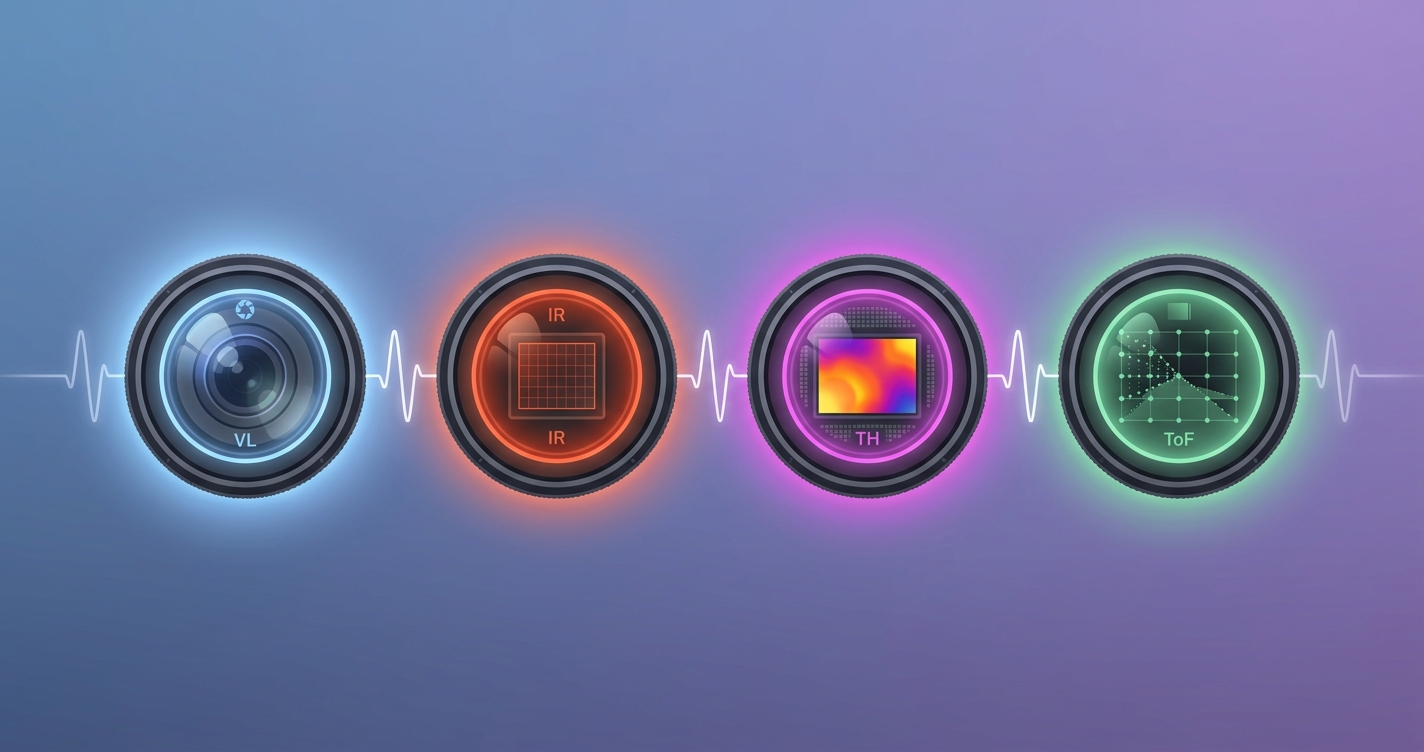
The table below ranks the four camera categories most commonly considered for embedded vitals against the criteria that actually predict rPPG performance. Ratings are relative suitability for reading vitals, not general image quality.
| Camera type | Pulse signal strength | Low-light / dark operation | Skin-tone robustness | Motion tolerance | Typical BOM cost | Best-fit use case |
|---|---|---|---|---|---|---|
| RGB (rolling shutter) | High (green channel) | Poor | Moderate | Low | Low | Smart mirrors, tablets, kiosks in controlled light |
| RGB (global shutter) | High | Poor | Moderate | High | Medium | Fitness, retail, moving subjects in good light |
| Near-infrared (NIR) | Moderate | Excellent | Higher than RGB | High | Medium | In-cabin automotive, sleep, night monitoring |
| Thermal (LWIR) | Low for pulse, strong for respiration | Excellent | High | Moderate | High | Respiration, fever screening, privacy-sensitive |
| Depth / ToF | Low for pulse, strong for respiration | Good | High | Moderate | Medium-High | Respiration, motion gating, presence detection |
A few patterns hold across deployments:
- RGB remains the strongest raw pulse sensor when lighting is controlled, because visible green carries the most cardiac contrast.
- NIR is the pragmatic winner whenever the product must work in the dark or in uncontrolled light, which is why it dominates automotive cabins.
- Thermal and depth sensors are weak for heart rate but strong for respiration, since chest and nostril motion are easier to track than capillary color shifts.
- No single sensor wins everywhere, which is why the RGB vs near-infrared vitals question only resolves once the use case and lighting are fixed.
Industry applications and sensor choice for health AI
Automotive in-cabin sensing
Driver and occupant monitoring lives in the hardest lighting environment a vitals system will face: full sun, tunnels, and total darkness within the same trip. NIR cameras with active illumination are the default here because they decouple sensing from cabin lighting. The penalty is weaker pulsatile contrast, which pushes more of the burden onto a camera-specific model trained on that exact sensor and illuminator geometry. RGB rarely survives the night-driving requirement alone.
Smart mirrors, kiosks, and fixed installations
Where a subject faces a sensor in stable indoor light, RGB sensors deliver the best pulse signal at the lowest cost. The risk is auto-exposure and on-sensor processing that smooths away the signal. Locking exposure and accessing raw or minimally processed frames matters more than resolution. A global shutter helps if subjects move, but a rolling-shutter RGB part is often adequate for a stationary user.
Wearables, smart glasses, and iot devices
Power and form factor dominate here. Small NIR or low-resolution RGB modules are common, and the sensor often sees skin at an oblique angle or close range. These constraints make a generic vitals engine especially unreliable, because the training data behind it rarely matches the unusual optics. A camera-specific vitals model is frequently the only path to acceptable accuracy on constrained hardware.
Current research and evidence
Recent literature supports a sensor-by-sensor view rather than a universal winner. The Frontiers RGB-channel study (2023) confirmed green as the dominant cardiac channel in visible light while showing that channel performance shifts with recording conditions and subject activity. Work from the University of Toyama comparing RGB and NIR reflectance photoplethysmography during motion found that blue and green wavelengths lead for heart rate, with NIR offering a viable fallback, particularly where ambient light cannot be controlled.
A comparative analysis of RGB and infrared imaging photoplethysmography across frame rates, circulated on ResearchGate, reinforced that frame rate and modeling approach interact: deep learning methods narrow the gap between RGB and IR, but only when trained on representative data. Reviews in Sensors (MDPI, 2021 and 2023) consistently flag higher bit depth and stable frame rate as practical predictors of signal quality. A recurring caution across these studies is that accuracy degrades at elevated heart rates and under motion, which is a modeling and sensor problem combined rather than a flaw in any one camera type. The consistent takeaway for hardware teams is that the sensor sets the ceiling on achievable signal, and the model determines how much of that ceiling is reached.
The future of contactless health monitoring cameras
Three trends are reshaping camera selection for vitals through 2026. First, multi-spectral and hybrid modules that combine RGB and NIR on a single sensor are becoming cheaper, letting a device switch spectral mode by lighting condition rather than committing to one. Second, event-based and high-bit-depth sensors are entering reach for embedded products, promising better dynamic range for the sub-percent signal without the cost of industrial machine-vision parts. Third, on-device inference is moving the vitals model onto the same silicon as the image pipeline, which makes the pairing of a specific sensor with a model tuned to it the unit of design rather than an afterthought.
The common thread is that hardware and algorithm are converging into one decision. As sensors diversify, the assumption that a vitals engine validated on one camera will transfer to another grows weaker, not stronger. Teams that fix their sensor early and characterize its raw behavior will spend far less time chasing accuracy late in the program.
Frequently asked questions
What is the best camera for contactless health monitoring overall?
There is no single best camera. RGB sensors give the strongest pulse signal in controlled light, NIR wins in dark or uncontrolled lighting, and thermal or depth sensors are better for respiration than for heart rate. The right choice depends on your lighting, motion, and use case.
Is RGB or near-infrared better for reading vitals?
RGB carries more cardiac signal in good visible light because hemoglobin absorbs green strongly. NIR is more robust in darkness, across skin tones, and under variable ambient light. Many automotive and sleep applications favor NIR for that reliability despite its weaker pulsatile contrast.
Does a higher resolution camera improve vitals accuracy?
Not directly. Bit depth, exposure control, shutter type, and stable frame rate matter far more than megapixels. A 10-bit or 12-bit sensor with locked exposure usually outperforms a higher-resolution 8-bit camera that applies heavy noise reduction.
Can one vitals model work across different cameras?
Rarely with full accuracy. Each sensor has a distinct spectral response, noise profile, and optics, so a model trained on one camera tends to lose accuracy on another. A model tuned to the specific sensor and lighting typically performs much better.
Circadify is building custom-trained rPPG models matched to a specific camera, sensor, and use case, which is the part of the problem that off-the-shelf engines leave to chance. If you are selecting hardware for a contactless vitals product and want a read on how a candidate sensor will actually perform, request a sensor-fit review through a custom build inquiry.